
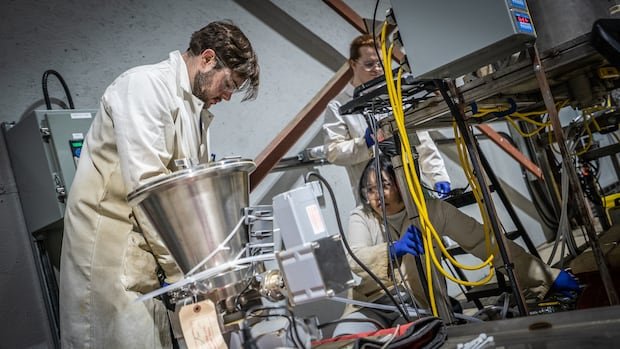

Researchers in Sudbury, Ontario, are focusing on expanding bacteria-powered technology to extract valuable metals from old mine waste on a larger scale. MIRARCO Mining Innovation is running a pilot plant to test how microbes can break down mine tailings, which are the leftover rock and sediment from mining activities, to release important minerals such as nickel, cobalt, and copper through a process known as bioleaching.
Although bioleaching technology is widely used in international mining, with about 30 mine sites globally incorporating it, Canada has not yet fully implemented it on a commercial scale, as stated by Nadia Mykytczuk, the CEO of MIRARCO, the research branch of Laurentian University. Mykytczuk, among others, recently showcased the 10,000-square-foot pilot facility in Sudbury to CBC, providing an insight into the bioleaching process.
Despite the significant value of the waste material, companies have been hesitant to invest in reprocessing tailings due to the high costs associated with sending the material back to the smelter. Typically, tailings are mixed with water and stored in large ponds, raising concerns about long-term environmental risks.
Jaime Kneen, the national program co-lead at MiningWatch Canada, highlighted the environmental risks associated with storing tailings, including potential chemical reactions leading to acid generation and metal release into the surroundings. To mitigate these risks, tailings are often stored underwater, which poses the challenge of maintaining dam integrity over long periods to prevent environmental disasters like the Mount Polley mine tailing dam collapse in 2014.
Both federal and provincial governments are emphasizing the development of critical minerals to secure clean energy technology and national defense supply chains, given the increasing global demand and the necessity to reduce dependence on unreliable suppliers. Mykytczuk believes that bioleaching can address the demand for critical minerals while also aiding in mining cleanup efforts.
The bioleaching process involves grinding down tailings and combining them with a liquid solution to feed the bacteria that assist in breaking down the minerals. As the bacteria interact with the minerals, chemical reactions occur, allowing the metals to separate and transfer into the liquid. The resulting slurry is then processed through a series of reactors for metal extraction. Researchers are striving to replicate this process on a larger scale for mining operations.
Furthermore, the team is exploring methods to convert the extracted metals into industrially applicable products. The goal is to transition from pilot testing to full-scale operations within the next two to three years in Canada, aiming to establish a successful commercial bioleaching operation.