
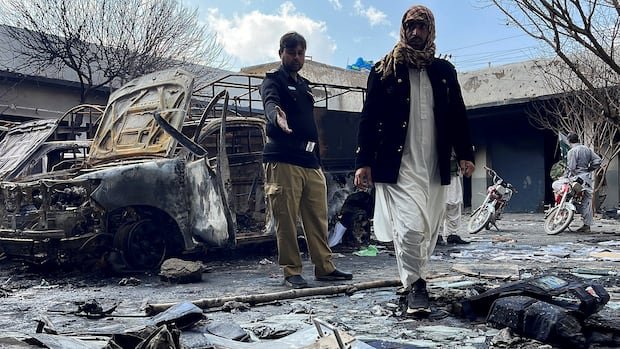

Pakistani security forces engaged in a 40-hour battle that resulted in the elimination of 145 militants following a wave of coordinated gun and bomb assaults in Balochistan, leaving around 50 individuals deceased, as stated by the province’s chief minister on Sunday. Balochistan, a resource-rich province bordering Iran and Afghanistan, is currently experiencing one of the deadliest escalations in years, with insurgents intensifying attacks on security forces, civilians, and infrastructure.
Disguised as civilians, assailants infiltrated hospitals, schools, banks, and markets on Saturday, launching indiscriminate attacks on people, as reported by Pakistan’s junior interior minister Talal Chaudhry. The militants utilized civilians as shields during the assaults. The Baloch Liberation Army, a banned separatist group, claimed responsibility for the attacks, declaring a coordinated operation called Herof or “black storm” targeting security forces across the province.
In Quetta, the provincial capital, the aftermath of the attacks was evident through burnt-out vehicles, bullet-riddled structures, and cordoned-off streets as security forces intensified patrols and restricted movement in the area. Chief Minister Sarfraz Bugti disclosed that the attacks resulted in the deaths of 17 law enforcement personnel and 31 civilians. Pakistan’s military reported the elimination of 92 militants on Saturday and 41 on Friday.
Bugti mentioned that preemptive measures were initiated based on intelligence reports indicating planned operations. The recent incident marked the highest number of militants neutralized in a short period during the intensified insurgency, as stated by Bugti, who did not provide comparative figures. The attacks, launched almost simultaneously in Quetta, Gwadar, Mastung, and Noshki districts, involved armed assailants targeting security installations, attempting suicide bombings, and obstructing roads in urban regions, prompting extensive counter-operations by army, police, and counterterrorism units.
Witnesses, such as private security guard Jamil Ahmed Mashwani, recounted the harrowing experience of being attacked. Balochistan, the largest and least affluent province in Pakistan, has been grappling with a prolonged insurgency led by ethnic Baloch separatists aiming for increased autonomy and a greater share of natural resources. The group asserted that they had eliminated 84 security personnel and captured 18 others, a claim that Reuters could not verify independently.
Pakistan’s Defense Minister Khawaja Asif highlighted the involvement of female perpetrators in two attacks, emphasizing the shift towards targeting civilians, laborers, and low-income communities by militants. The military affirmed that security forces thwarted all attempts by militants to seize control of cities or strategic installations.
Regarding the attacks, Pakistan’s military attributed them to “Indian-sponsored militants,” a claim refuted by India, which accused Islamabad of diverting attention from its internal issues. The United States condemned the attacks, labeling them as terrorist acts, with U.S. deputy chief of mission Natalie Baker expressing solidarity with Pakistan. The Balochistan Liberation Army is recognized by the U.S. as a foreign terrorist organization.
Pakistan has encountered sporadic assaults by Islamist militants in various parts of the country, including factions associated with the Pakistani Taliban.