
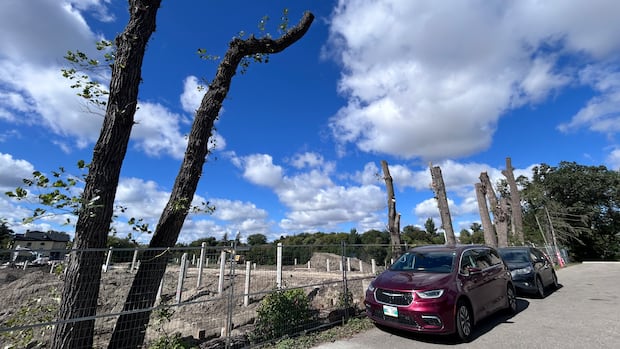

The massive trees that Diane Poulin once shared her surroundings with are no longer alive, but she aims to safeguard the remaining ones in Winnipeg.
“I had five mature elm trees right outside my home, creating a lovely canopy above the street, and now they are all gone,” she remarks.
In her backyard stood the largest of them all.
“He was like the neighborhood’s grandfather… his canopy enveloped our backyard, and now he is no longer here.”
The trees in the city face dangers from diseases, pests, and climate change, but options to combat these natural threats are limited.
Consequently, Poulin and other supporters from Trees Please Winnipeg are also advocating against another threat—property owners.
The organization is urging Winnipeg to establish a bylaw to regulate the removal of trees on private properties, as currently, there are few restrictions preventing owners from cutting down any trees, regardless of their size.
Advocates like Poulin argue that preserving the urban canopy is vital due to the numerous advantages trees provide to residents, including offering shade during heat waves, purifying the air, managing rainwater, and enhancing the city’s aesthetics.
With over 80 percent of the city’s trees located on private land, she emphasizes the necessity of finding a method to protect those trees as well.
To increase pressure, Trees Winnipeg has encouraged candidates in the municipal election to endorse a pledge committing to the implementation of a bylaw that would regulate the removal of all trees exceeding 15 centimeters in diameter.
Several cities across Canada already possess some version of a private tree bylaw, which typically allows for the removal of trees for development or if they are unhealthy, but not simply because someone wishes to avoid raking leaves.
Surrey, B.C., enacted protections in 2006, and cities such as Ottawa, Vancouver, and Toronto have since followed suit. Edmonton is currently developing its own bylaw.
“We are really lagging behind in this area,” Poulin states.
Approximately 75 percent of candidates have signed the pledge, she notes, although there are significant gaps, including incumbent mayor Scott Gillingham.
During a recent campaign event, he expressed pride in his record regarding trees, which includes increased funding and a higher replacement rate for trees in the city. However, he only agreed to let the council discuss a bylaw for protecting trees on private property, not to actually pass one.
“We need to examine what it entails, what the specific requirements would be, and the conditions of any bylaw,” he remarked.
The mayor and council have recognized the strong feelings many Winnipeggers hold toward trees. When city officials attempted to address a financial shortfall this summer by cutting the forestry budget, the public outcry prompted them to reverse their decision.
Concerns Regarding Private Property
However, imposing regulations on private property owners regarding their trees can also evoke strong reactions.
In Toronto, for instance, such bylaws have resulted in angry homeowners who have been prohibited from removing their mature ginkgo trees, even as the trees began to bear their unpleasant-smelling fruits.
A similar bylaw might have complicated matters for Paul Taylor, who sought to clear-cut his tree-laden lot in Winnipeg, which essentially extended the city’s Assiniboine forest.
Taylor stated he acted out of security concerns, as the trees concealed his family’s old home from the street, leading to break-ins and vandalism, prompting him to demolish the entire place.
The business owner expresses support for a bylaw to protect trees, provided it accommodates legitimate safety and liability concerns. He also advocates for a requirement to replant trees, which he intends to do on his property.
“I generally support the protection of Winnipeg’s urban tree canopy, and I don’t see it conflicting with being a developer,” he states.
Neighbors questioned about the clear-cutting were not quick to endorse laws against it.
Brian Paterson, a 67-year resident next door who cherished the view of the ancient oaks and other trees, believes that, within reason, individuals should make their own decisions regarding their properties.
“Would I prefer the trees remained? Yes, but he has a right to do what he wants with his property.”
Nuances of the Law
Across the street, Bianca Johnson states she supports the idea of tree protection but is concerned about how far such laws might extend and the potential complications someone might face in dealing with, for instance, a diseased tree.
“In general, it sounds great, but the specifics are always the crucial details,” Johnson mentions.
“There’s always a balance between individual rights and community rights.”
While such bylaws may restrict personal freedoms, they are not dissimilar from many existing regulations, noted Erna Buffie, who published a book this year about preserving the urban canopy.
“I must obtain a permit to undertake any renovation on my property or home, yet I can freely cut down a 100-year-old tree without any consequences,” she points out.
“There’s something fundamentally flawed about that.”
She notes that the current absence of protections means, for instance, that the owner of the Lemay Forest was legally permitted to cut down approximately 17,000 trees on the property. The forest, along with the graves within it, was only preserved when the province intervened to expropriate it last year.
With the city’s trees remaining largely unprotected, Poulin from Trees Please is also actively working to plant new ones.
She helped gather funds to plant eight trees across from her home, even though she won’t be around to witness them reach the magnificence of those they replaced.
“We do this for the future generations of Winnipeggers and their children and grandchildren, who deserve to inherit a livable city.”