
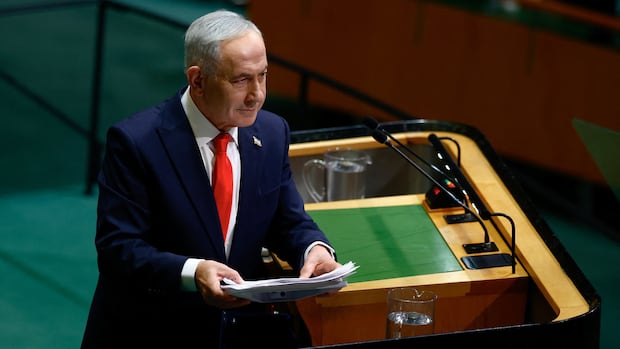

An analysis of two years of flights by Israeli Prime Minister Benjamin Netanyahu indicates that he is once again consistently taking a more direct route — through Canadian airspace — to reach the United States, despite the international arrest warrant that Canada has pledged to uphold.
Canada has faced criticism for contradicting its public commitment to international law by allowing Netanyahu to traverse its airspace. Throughout this period, the federal government’s justification for this action has evolved.
European nations seem divided over whether the obligation to enforce the warrant extends to sovereign airspace.
The French government, which has also permitted Netanyahu to fly through its airspace, has stated it will enforce International Criminal Court (ICC) arrest warrants against Israeli officials, but has also claimed it has no requirement to do so in the air.
Pascal Confavreux, spokesperson for the French Foreign Ministry, remarked following Netanyahu’s latest flight that “the Rome Statute does not impose any obligations concerning the overflights of its territory by a state plane carrying a passenger subject to an arrest warrant,” referring to the treaty that established the ICC.
France stands out for explicitly stating its interpretation of its obligations under the Rome Statute. Italy and Greece have also allowed Netanyahu to overfly their territories, but both have refrained from clarifying their legal justifications.
A statement from the Prime Minister’s Office earlier this summer was less straightforward, indicating that Canada’s “law enforcement objectives” are not typically associated with who is allowed to fly through Canadian airspace.
The applicability of the Rome Statute to airspace is a topic of debate among international law specialists.
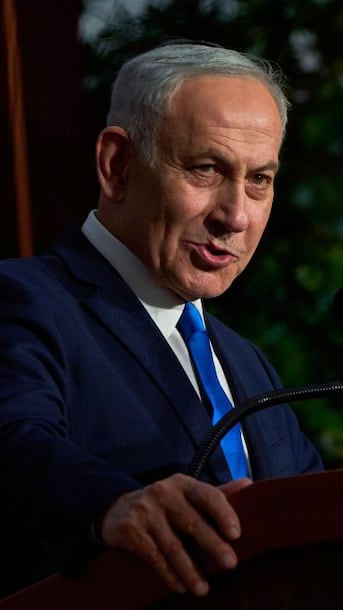
Israeli Prime Minister Benjamin Netanyahu entered Canadian airspace on his way to Washington, D.C. The federal government won’t say whether it let him do it.
Ardi Imseis, co-director of the international law program at Queen’s University and a member of the Group of Eminent International and Regional Experts, a commission of inquiry mandated by the UN Human Rights Council to investigate humanitarian law violations in the Yemeni conflict, stated, “Canada is a state party to the Rome Statute of the International Criminal Court, which necessitates that it arrest and surrender any individual subject to an arrest warrant issued by the court,” in remarks to CBC News.
“Thus, Canada has violated its obligations as a state party to the Rome Statute by allowing Netanyahu to enter Canadian airspace en route to the United States.”
Flight data indicates that Netanyahu’s fears regarding the risks of international travel peaked in late 2025, with his flight to New York that year consuming a significant amount of extra fuel to avoid European airspace, largely remaining over the Mediterranean before entering the Atlantic Ocean via the Strait of Gibraltar.
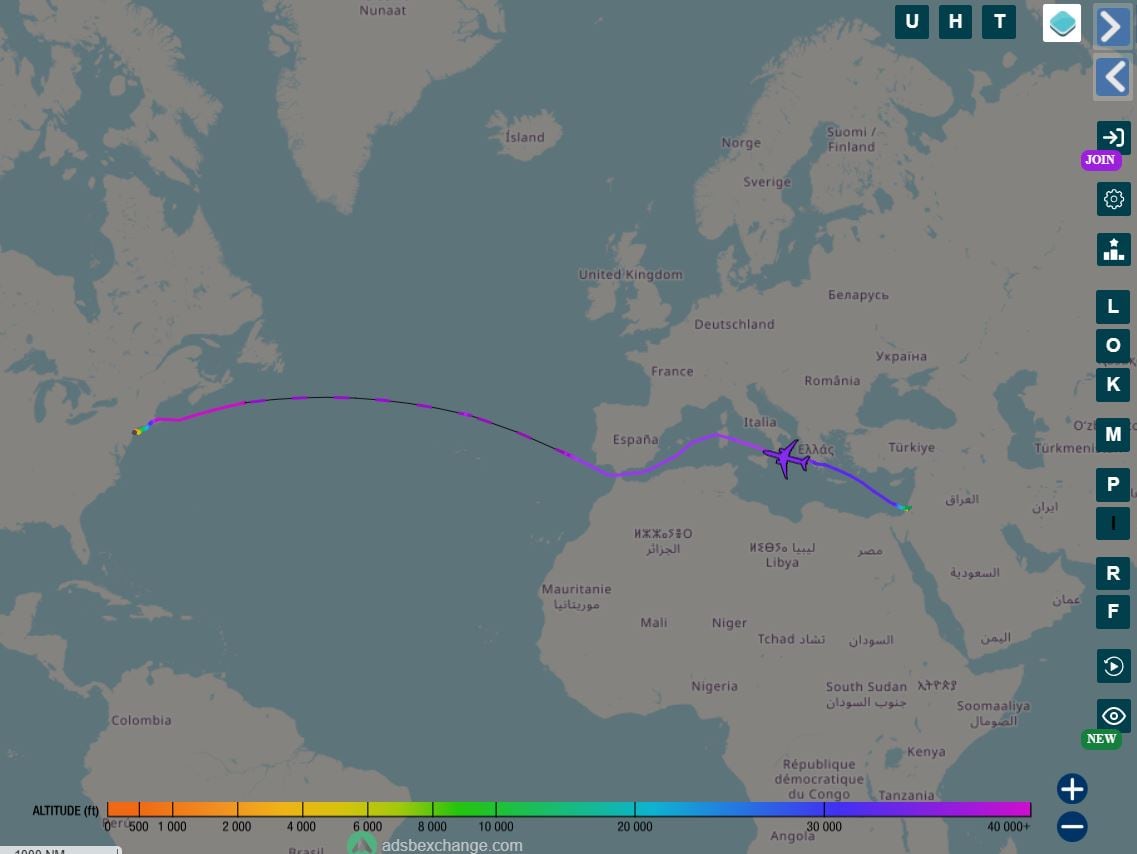
During his previous visit to the UN General Assembly in September 2025, Netanyahu’s government jet avoided much of the European landmass, flying through the international Strait of Gibraltar. (ADS-B Exchange.)
Certain nations, such as Slovenia and Turkey, have openly declared that their airspace is off-limits to the Israeli leader. In other instances, like Spain, no official ban has been issued, but Netanyahu’s aircraft has taken noticeable detours to avoid airspace. His plane has also continued to stray from the quickest Great Circle route to bypass either Irish or British airspace, which are aligned on the same trajectory.
In November 2024, the ICC issued an arrest warrant for Netanyahu for alleged war crimes, including “starvation as a method of warfare” and “intentionally directing an attack against the civilian population.” The Israeli government has denied the allegations.
Evolving justifications
The Canadian government has been hesitant to clarify whether it provided permission for the flights.
Nonetheless, on the last two occasions, it has offered responses.
Netanyahu’s latest flight — on September 24 for the United Nations General Assembly — was also the most extensive into the Canadian mainland since the warrant was issued, traversing Labrador and a significant portion of Quebec.
As the UN convened in Manhattan, Canadian Foreign Affairs Minister Anita Anand informed reporters that she was unsure if Netanyahu would pass through Canada.
“I have actually requested my department to provide me with information regarding this specific flyover, which I did not have before arriving at the United Nations,” Anand stated to reporters outside UN headquarters a day before Netanyahu’s arrival.
To conduct that flight, Netanyahu would have needed to secure permission from Anand’s department at least two days prior to her comments, in accordance with Canadian protocol regulations.
Myah Tomasi of Global Affairs Canada later remarked that the decision was made out of respect for the traditions of the United Nations.
“Any authorization to traverse Canadian airspace should not be interpreted as an endorsement of the policies or actions of any specific government,” she stated.
“In this instance, the overflight request was related to the United Nations General Assembly, a vital platform for diplomatic engagement.”
Despite this stance from the Carney administration, Netanyahu’s aircraft, referred to as the Wing of Zion, notably avoided Canadian airspace during his trip to the UN General Assembly last year.
On July 27, when the United Nations was not on his agenda, Netanyahu’s Boeing 767-300 also crossed over Newfoundland and Nova Scotia en route to a meeting with U.S. President Donald Trump in the Oval Office.
The Israeli Embassy informed CBC News that it had requested approval from the Carney government for Netanyahu’s jet to transit Canada. The embassy did not respond to inquiries about the most recent flight.
Following that flight in July, and the statement from Israel, Prime Minister’s Office spokesperson Audrey Champoux informed CBC News that “Canada does not currently associate its overflight policy with law enforcement objectives except in cases of imminent security threats.”
Separately, a spokesperson from Global Affairs Canada told CBC News that “Canada’s stance remains that, as a state party to the Rome Statute of the International Criminal Court, it must fulfill its obligations under the statute and international law.”
Netanyahu’s inaugural flight during the Carney era took place in July 2025, transporting the Israeli leader to Washington for meetings with Trump and congressional members. On that occasion, the Wing of Zion skirted just outside Canadian airspace near Newfoundland before entering U.S. airspace close to Atlantic City, N.J.
The flight prior to that, in February 2025, marked Netanyahu’s first trip to the U.S. following the issuance of his arrest warrant and occurred while Justin Trudeau remained prime minister. Trudeau had committed to uphold the ICC warrant, though without clarifying whether this applied to Canadian airspace. Carney subsequently made a similar pledge.
Regardless, that flight avoided Canadian airspace, entering the U.S. at the mouth of Delaware Bay.
Concerns about support for the court
Some experts in international law have argued that by not strongly upholding the authority of the ICC, Canada is inadvertently assisting those in the Trump, Putin, and Netanyahu administrations who aim to undermine it. (Neither the U.S. nor Israel are signatories to the Rome Statute, and Russia withdrew a decade ago.)
“On one hand, Canada asserts that it believes in the international rule of law and presents itself as a staunch supporter of the ICC,” Imseis noted.
“Conversely, Canada’s failure to fulfill its clear obligations to arrest and surrender Netanyahu reflects a commitment to lawlessness.”
“In simple terms,” he added, “Ottawa has permitted a fugitive from international justice to continuously utilize its territory to evade criminal accountability.”
Errol Mendes, a former senior advisor to the Privy Council who teaches law at the University of Ottawa, expressed that he is less troubled by the overflights but is concerned about what he perceives as a broader pattern of neglect towards the International Criminal Court.
“That court is now in significant jeopardy due to the Trump administration’s efforts to dismantle it, not only by sanctioning individual judges, including Canadian Kim Prost, but also by financially constraining the court through freezing all financial operations involving the U.S.,” he told CBC News.
Mendes argues that as a founding member of the court, Canada has a strong duty to defend it, “including by countering the financial and other sanctions imposed by the Trump administration.”
“Failing to do so,” Mendes warned, “could lead to the court’s collapse, which would be catastrophic for the international rule of law and the global commitment to combat impunity for the most serious international crimes.”
Tag: rewrite-pending