
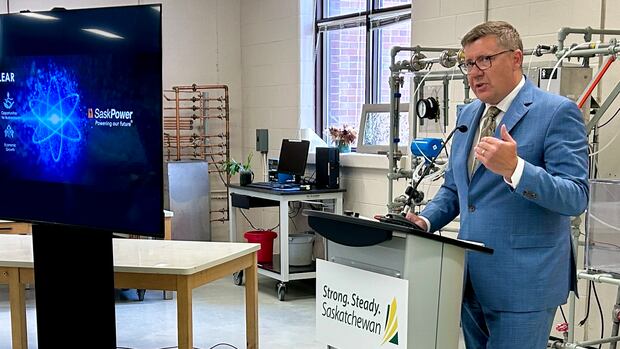

Saskatchewan is making significant strides in nuclear energy, with announcements regarding the exploration of two large nuclear reactors in the province’s northwest and the ambition to have the first reactor operational by 2042.
The Saskatchewan government has also revealed that it has identified the Rafferty site near Estevan as the focus for further investigation into the construction of small modular reactors (SMRs).
During a press conference at the University of Saskatchewan on Tuesday, Premier Scott Moe stated that the province’s new initiative, Delivering Energy Security Through Nuclear Power, aims for an initial target of generating 2,600 megawatts (MW) of nuclear power by 2050.
“We are paving the way for one of the most substantial energy and economic development prospects in the history of our province,” Moe expressed.
“Six hundred megawatts can supply power to Saskatchewan’s two largest cities, Regina and Saskatoon, while 2,600 megawatts could provide electricity to about 2.6 million homes.”
Moe noted that this initiative will ensure the necessary electricity to accommodate a growing population, significant industrial projects, and expanding sectors.
He refrained from discussing the specific financial investments required for the project, mentioning that the global trend in nuclear reactor construction has led to reduced building costs.
Moe also indicated that funding for these reactors could be sourced from private companies or other investors.
Jeremy Harrison, Minister of Crown Investments Corporation, stated that the plan emphasizes four key priorities for nuclear development:
- Enhancing electricity capacity for sustainable growth.
- Integrating large nuclear reactors into the province’s electricity supply strategy.
- Advancing nuclear development in Estevan.
- Building upon existing nuclear expertise.
While confirming that plans for large nuclear reactors and SMRs are being developed concurrently, Harrison expressed openness to adapting the province’s strategy.
“I would keep the option available for large-scale deployment in locations not only in the northwest but also in the southeast,” he remarked.
Large nuclear reactors
The target of 2,600 MW for nuclear energy generation represents a substantial increase in Saskatchewan’s nuclear ambitions, which had previously focused solely on SMR development.
For reference, SaskPower reported that the total power system demand reached 2,829 MW at 10:30 a.m. CST on Tuesday. The highest recorded power usage in the province was 3,910 MW on December 30, 2021.
The selected SMR technology for Saskatchewan, the Hitachi BWRX-300, generates around 300 MW from a single unit.
Although SaskPower had indicated a desire to explore large nuclear technology in the past, Tuesday’s announcement marks the first time the government has provided concrete details.
The specific locations for the two large nuclear reactors were not confirmed on Tuesday, but Moe has previously hinted at potential sites along the North Saskatchewan River.
SaskPower stated that it will assess potential locations while ensuring “meaningful engagement with local communities and Indigenous peoples.”
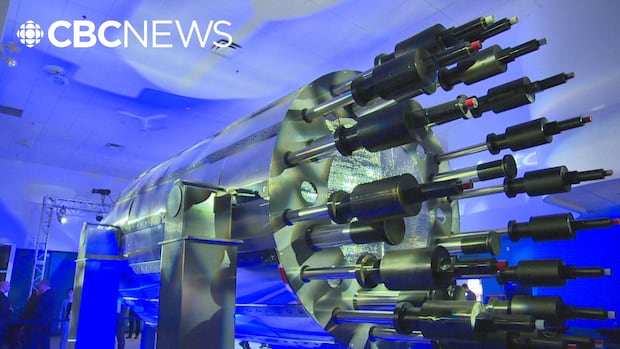
On Jan. 28, SaskPower and the province announced their hopes to make nuclear power generation happen in Saskatchewan.
The provincial government did not explicitly state which type of nuclear reactor would be utilized for the large-scale projects, but the news release mentioned John Gorman, president of Westinghouse Canada, and Ian Edwards, president and CEO of AtkinsRéalis.
Westinghouse and Cameco manufacture the AP1000 Gen III+ reactor, which is referenced in the announcement.
Some of these large-scale reactors are already operational in China and the United States, each generating approximately 1,100 MW.
AtkinsRéalis specializes in CANDU technology and also produces the Candu Monark reactor, which has a power output of about 1,000 MW.
Unlike the AP1000 reactor, the Candu Monark does not require enriched uranium as fuel.
As Canada lacks domestic uranium enrichment facilities, Saskatchewan would need to import enriched uranium.
David Pickup, director of electricity research at the Pembina Institute, a Canadian clean energy think tank, stated that Saskatchewan possesses sufficient uranium to support the reactors.
“The province has a substantial amount of uranium, which is already being mined for other nuclear facilities in Ontario and beyond,” Pickup mentioned.
He noted that the government’s proposal aligns with timelines of other similar nuclear initiatives.
Pickup also emphasized the need for the Saskatchewan government to develop a sustainable energy plan and transition away from coal-generated power before the reactors become operational.
“It’s crucial to understand that achieving the net-zero target by 2050 is not just about reaching zero emissions; the pathway we take to get there is equally important,” Pickup stated.
M. V. Ramana, a public policy professor specializing in nuclear energy at the University of British Columbia, expressed skepticism regarding nuclear power as a solution, especially with the advancement and affordability of renewable energy sources.
“While a larger nuclear power plant may offer some economic benefits in terms of electricity generation and cost per unit, the initial investment required is substantial,” Ramana explained.
He raised concerns about the project’s costs and the safety measures considered.
“Making announcements is straightforward; however, the actual construction of a nuclear power project presents many challenges,” Ramana added.
SMR site selection
SaskPower has also confirmed that it has further narrowed its options for SMR placement in southeast Saskatchewan.
The Crown corporation previously indicated that it had two primary choices: a site at the Boundary Dam Reservoir in the Rural Municipality of Estevan and a location at the Rafferty Reservoir in the Rural Municipality of Cambria.
SaskPower announced on Tuesday that it has selected the Rafferty site for “further study.”
Estevan remains a crucial component of the province’s nuclear power strategy, with the objective of providing at least 600 MW of nuclear energy, equivalent to two Hitachi BWRX-300 units.
A final decision regarding the site is expected later this year, according to the SaskPower project timeline.
The first SMR is anticipated to be operational by the mid-2030s, as indicated in the same document.