
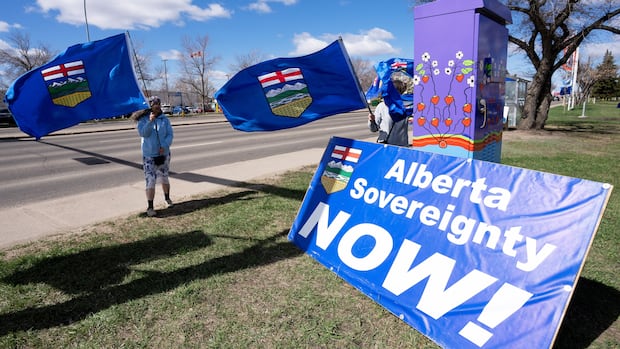

Internal federal records provide valuable information on Ottawa’s evaluation of the economic repercussions if Alberta were to separate from Canada and establish itself as an independent nation.
The documents from Finance Canada and the Justice Department also reveal the potential outcomes being assessed due to the uncertainties surrounding Alberta’s separatist movement.
Briefing notes from Finance Canada, obtained by CBC News through access to information laws, indicate that the federal government has been discreetly examining the ramifications of a possible $18-billion fiscal shock, the relocation of corporate headquarters, and a significant migration of Albertans to nearby provinces should Alberta decide to leave the federation.
The documents also highlight concerns that federal pension regulations are “imperfect” and may not adequately address the implications of Alberta withdrawing from the Canada Pension Plan.
Although many sections of the documents have been redacted, they still provide insights into various scenarios the government is contemplating this fall.
The records are dated June 2026.
On October 19, Alberta will hold a referendum asking residents whether the province should remain part of Canada or schedule another vote in the future regarding independence. So far, most analyses regarding the economic impact of Alberta’s potential separation have focused primarily on the effects for the province itself rather than for Canada as a whole.
Despite polls indicating that more Albertans prefer staying in Canada than leaving, the documents suggest that even the mere prospect of a separation referendum could inflict economic damage on both Canada and Alberta.
Departure of Corporate Headquarters
The analysis references the 1995 Quebec referendum, in which Quebec voters narrowly chose to stay in Canada.
According to data from bond and equity markets, that vote was associated with “tightening in financial conditions both provincially and nationally,” the documents assert.
It notes that businesses postponed “investment decisions while awaiting more clarity on future economic arrangements.”
-
Poll suggests slight majority of UCP voters favours separation
-
Everything you need to know about the Alberta referendum
Quoting data from the Conseil du patronat du Québec from the late 1970s and early 1980s, the documents reveal that 263 major corporate headquarters, including Sun Life, relocated from Montreal.
“Ongoing uncertainty in Alberta could provoke a similar wave of corporate headquarters departures, particularly among companies in sectors other than resources,” the documents warn.
Under the section labeled “interprovincial population outflow,” it is noted that in 2021, Alberta welcomed nearly 17,500 net workers with post-secondary degrees — and it implies that a significant number of highly educated and skilled workers would likely depart from an independent Alberta.
CBC News inquired with Finance Canada for additional information regarding the department’s analysis of the Alberta referendum’s effects.
In response, the Privy Council Office provided an emailed statement indicating that the federal government is “conducting its own study of various third-party economic analyses” regarding the potential financial implications of Alberta’s separation from Canada.
“Alberta is a crucial part of Canada and plays a significant role in the prosperity of both Albertans and Canadians. Alberta is stronger as part of a united Canada,” wrote Privy Council spokesperson Mélany Gauvin.
15% of National GDP
This analysis underscores the substantial contributions of the Alberta economy to the rest of Canada.
From 2022 to 2024, Alberta’s net fiscal contribution averaged around $18 billion each year.
With the province generating $475 billion in annual economic activity, Alberta has accounted for 15 percent of the national GDP over the past decade.
During the same timeframe, Alberta also represented 31 percent of Canada’s exports, primarily driven by the energy sector.

With just weeks remaining until the referendum, CBC News spoke with ranchers in southeast Alberta to gather their voting intentions and what the outcomes might mean for their livelihoods.
Economist Trevor Tombe from the University of Calgary has conducted a comparable analysis on the ramifications of separation. Tombe, who is affiliated with the federalist group Lead Not Leave, points out that in 2024, Ottawa collected over $19 billion more than it spent in the province.
An independent Alberta would retain that revenue, but Tombe’s report suggests it would shortly be consumed by NATO defense obligations, costs associated with taking over federal responsibilities, and diminishing revenues from a contracting economy.
In a conversation with CBC News, Tombe emphasized that while Canada would incur significant losses if Alberta were to leave, the province itself would be the greatest loser.
“It is certain that Alberta would face the most substantial economic disruption as a result of separation,” Tombe remarked.
Implications for the Canada Pension Plan
Tombe has also analyzed the effects of Alberta’s withdrawal from the Canada Pension Plan.
The CPP was created in 1966 to provide retirement income for older Canadians and to address deficiencies in private pension plans.
While the plan includes provisions for opting out and a method for asset transfers, the internal document indicates that the chief actuary, acting as the federal government’s independent overseer of the CPP, has expressed concerns regarding the language and payout formula stipulated in the federal legislation governing the pension scheme.
“Beyond the law being subject to interpretation, the chief actuary has noted that the formula provided is flawed,” the documents state.
When the CPP and its accompanying legislation were established in the 1960s, its assets were allocated to provincial bonds.
Currently, however, the fund’s investments include infrastructure such as airports, equities, and other global bonds — complicating the process of divesting Alberta’s share.
“I would expect that if a province chose to exercise its right to withdraw, the Supreme Court would need to adjudicate what the language in the act ultimately signifies,” Tombe noted.