
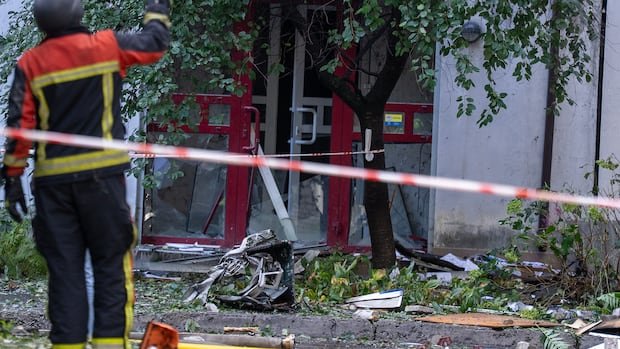

A high-rise residential building in Kyiv was struck by a Russian drone on Friday morning, resulting in the death of a 14-year-old boy and injuries to several others. The aftermath of the attack revealed remnants of a jet engine amidst shattered glass and debris on the ground.
Russia has been utilizing advanced jet-powered drones to launch strikes on Kyiv, targeting various facilities such as offices, data centers, and warehouses. These drones, flying at high altitudes with speeds exceeding 600 km/h, have been challenging for Ukrainian air defenses to intercept due to their swift and evasive nature.
Volodymyr Khomenko, the head of the Explosive Ordnance Disposal Department of the National Police of Ukraine, highlighted the difficulty in intercepting these drones, emphasizing the need for faster interceptors to effectively counter the threat.
Ukrainian officials reported that Russia began testing jet-powered strike drones in the Chernihiv region two years ago. These new drones, part of the Geran series, feature turbojet engines sourced from China and exhibit enhanced speed and design compared to earlier models.
The usage of jet-powered drones by Russia has increased significantly, with Ukrainian Air Force intercepting about 60% of these drones, a lower success rate compared to previous models. Efforts are underway to accelerate the production of advanced interceptors to counter the evolving drone warfare tactics employed by Russia.
In response to the escalating drone threats, Ukrainian President Volodymyr Zelenskyy emphasized the importance of developing effective countermeasures to target drone manufacturing facilities and launch sites. The ongoing conflict has led to a continuous adaptation of tactics and technology by both sides in a rapidly evolving “cat-and-mouse game.”
The relentless drone attacks have created a sense of fear and uncertainty among residents in Kyiv, with the need for improved defense strategies to mitigate the impact of these sophisticated aerial threats.