
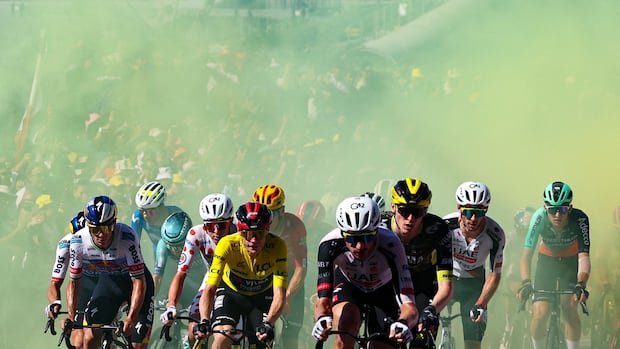

Professional cyclists from around the world are gathering in Montreal for the UCI Road World Championships, but the shadow of tragedy hangs over the event. This year, at least 11 cyclists have lost their lives during races and training sessions, adding to a concerning number of injuries and fatalities in the sport. The ongoing debate in professional cycling revolves around the balance between speed and safety, with advancements in safety gear and faster bicycles raising questions about prioritizing rider protection.
The current average speed of the Tour de France winner stands at 43.3 km/h, a significant increase from a century ago. Riders now reach speeds well over 100 km/h on descents, prompting discussions within the Union Cycliste Internationale (UCI) and SafeR, an international safety taskforce, about implementing safety measures. Proposals include incorporating safety technologies like wider handlebars, selecting safer race routes, real-time rider tracking, and introducing protective gear such as airbags.
The topic has sparked division among cyclists, with some advocating for speed while others, like former professional cyclist Adam Hansen, acknowledge the need for safety enhancements. Canadian cyclist Michael Woods, who has experienced numerous crashes during his career, emphasizes the necessity of changes to prevent future tragedies. Woods and Hansen support the mandatory use of GPS trackers in races, a safety measure that can transmit immediate crash data for prompt emergency response.
Following the tragic death of Swiss cyclist Muriel Furrer during the 2024 championships, GPS trackers were introduced at the UCI Road World Championships in Rwanda last year. Woods, who witnessed Furrer’s accident, highlights the need for safety improvements in professional cycling and the importance of adopting technologies like GPS trackers to enhance rider safety.
In addition to GPS trackers, the discussion has extended to the potential use of airbags in cycling. The UCI has called for the development of airbag systems integrated into bike frames or cycling apparel to reduce the impact of crashes on riders. While prototypes are being tested by World Tour teams, the approval and implementation of airbag technology in UCI races remain uncertain.
Beyond technological advancements, the design of cycling courses also plays a crucial role in ensuring rider safety. Studies have shown that certain elements, such as bike lanes with obstacles like bollards or speed bumps, can pose risks during races. The preference for rural race locations with minimal infrastructure aims to reduce potential hazards for cyclists in high-speed competitions.
As professional cycling continues to evolve, the focus on safety measures and equipment innovations remains imperative in safeguarding the well-being of riders. The ongoing debate between speed and safety underscores the importance of finding a balance that preserves the thrill of the sport while prioritizing the protection of cyclists.