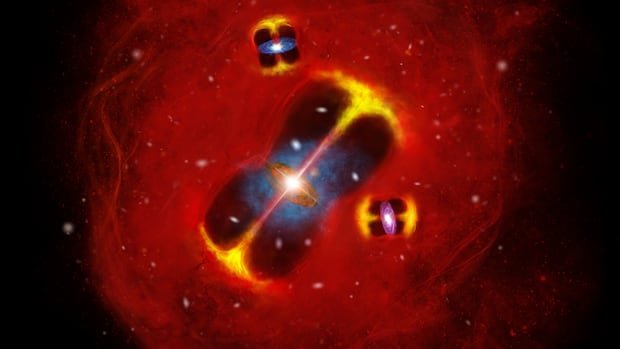

A team led by a University of British Columbia astrophysicist has made a groundbreaking discovery of a young galaxy cluster emitting hot gas at a rate five times higher than previously thought possible. This finding, published in the Nature journal, challenges existing views on the early universe’s evolution post-Big Bang.
The study, involving over two dozen researchers worldwide, focused on the galaxy cluster SPT2349-56 located approximately 12 billion light years away. Led by UBC PhD candidate Dazhi Zhou, the team observed a significant presence of hot gas in the intergalactic space.
Zhou emphasized the significance of detecting such intense hot gas in a “young” galaxy cluster, which formed only 1.4 billion years after the Big Bang, marking a significant advancement in understanding universal dynamics.
The director of the Dominion Astrophysical Observatory, James Di Francesco, noted that previous theories did not anticipate such rapid heating of galaxy clusters. The unexpected heating of the gas in this early cluster challenges conventional assumptions and offers new insights into cluster evolution.
The researchers utilized telescopes in Chile to explore dark clouds, delve into star formation, and investigate the early universe. By employing radio telescopes that observe short wavelengths, the team could accurately measure the gas’s temperature despite its vast distance from Earth.
Galaxy clusters, comprising clusters and superclusters of galaxies, can house hundreds to thousands of galaxies. The study’s findings are crucial in unraveling the formation processes of modern galaxy clusters.