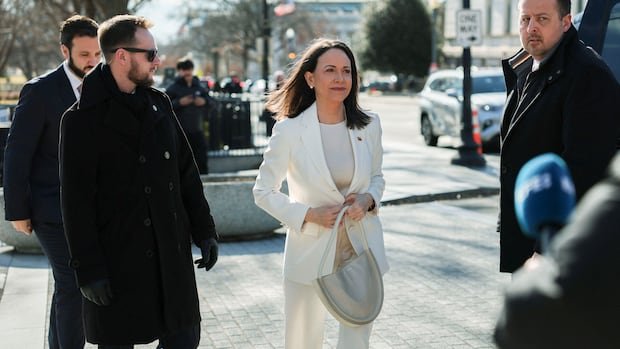

Venezuelan opposition figure Maria Corina Machado presented her Nobel Peace Prize to President Donald Trump during a recent White House meeting in an effort to influence the future political landscape of Venezuela. A White House representative confirmed that Trump plans to retain the medal.
In a social media message posted by Trump, he expressed gratitude for Machado’s gesture, acknowledging her recognition of his dedication to the freedom of the Venezuelan people. Machado, describing the meeting as “excellent,” explained her action as a token of appreciation for Trump’s commitment.
This move by Machado followed Trump’s rejection of the idea of appointing her as Venezuela’s leader in place of the ousted Nicolás Maduro. Trump had actively campaigned for the Nobel Peace Prize before Machado received it, expressing disappointment when he was not selected.
Despite Machado giving Trump the physical medal that accompanies the award, the Nobel Prize itself remains with her, as clarified by the Norwegian Nobel Institute. During their face-to-face meeting, which lasted about an hour, Machado also engaged with a group of senators on Capitol Hill, seeking support for her role in Venezuela’s governance.
Meanwhile, the U.S. recently captured Maduro in a covert operation, prompting optimism among various opposition figures and Venezuelan diaspora members for the country’s democratization process to commence. However, Trump emphasized his focus on rebuilding Venezuela economically and ensuring U.S. access to its oil resources.
The meeting between Trump and Machado coincided with the U.S. seizure of another Venezuela-affiliated tanker, the sixth vessel targeted in a series of recent operations. The U.S. military’s Southern Command confirmed the apprehension of the tanker Veronica, emphasizing adherence to Trump’s sanctions on vessels involved in the Venezuelan oil trade.
As part of efforts to pressure Maduro, the U.S. government has intensified its control over Venezuela’s oil resources, targeting vessels associated with sanctioned producers like Iran, Russia, and Venezuela. The intercepted vessels, often masking their identities, have faced seizure actions by U.S. authorities.
The recent capture of a Russian-flagged tanker shadowed by a submarine drew criticism from Moscow, underscoring the escalating tensions surrounding U.S. actions in the region.