
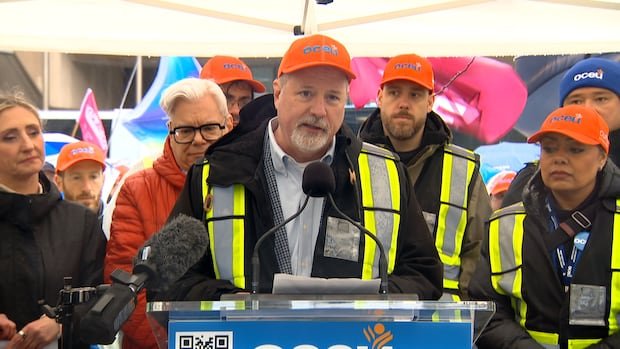

Amidst recent staff reductions at the Workplace Safety and Insurance Board (WSIB) in Ontario, certain employees and their union are expressing worries about the agency’s utilization of artificial intelligence (AI). The Ontario Compensation Employees Union (OCEU), representing WSIB staff, disclosed the layoffs earlier this month, affecting a total of 566 individuals, including unionized and non-unionized workers, as stated by OCEU president Harry Goslin in an interview with CBC News.
Brittnee Gauthier, who worked as a post-adjustment case manager in Sudbury, found herself among those let go. Gauthier mentioned that prior to the job cuts, WSIB had been actively introducing a new AI claim summary tool internally to analyze and summarize documents. Expressing her thoughts, she remarked, “It seems like AI is the future for this company.” She added, “While I believe AI can be beneficial, we were all enthusiastic about this new tool until realizing it was rendering us all redundant. This makes me concerned about who might be next.”
President Goslin expressed the union’s apprehension regarding how WSIB will manage claims moving forward, suggesting that the layoffs are primarily focused on automating tasks. In response to the layoffs, WSIB characterized them as a “challenging business decision” when initially announced. They emphasized their continuous efforts to modernize operations and provide optimal support while ensuring value for the premiums paid by Ontario businesses.
WSIB’s records revealed a $7.3 million contract awarded to Owl.co for a “claims summary tool subscription” in February. Furthermore, WSIB CEO Jeff Lang is slated to speak at a conference in Las Vegas alongside Owl.co CEO Sean Merat in October, discussing WSIB’s extensive deployment of AI technology.
When inquired about the correlation between AI implementation and recent job cuts, WSIB emphasized their long-standing use of technology to streamline administrative tasks and allow staff to focus on aiding individuals in their recovery and return to work. They highlighted that tools like the claim summary tool facilitate quicker comprehension of claims by organizing information and documents.
Employees who were laid off recounted being informed through a brief group call with numerous others, leaving them with unanswered questions. Gauthier expressed her dismay, especially after leaving a decade-long career to join WSIB, fearing that injured workers will bear the consequences of the layoffs. She emphasized the urgency to process over 200 claims on her desk to prevent delays in assistance.
Discussing the potential impact on injured workers, Goslin highlighted that decisions should be made based on individual circumstances as outlined in legislation. He raised concerns about the potential diminishment of services to claimants due to the reliance on AI technology.
Sanjeev Kapoor, a customer service representative at WSIB in Sudbury affected by the layoffs, shared his concerns, mentioning that he and his wife believe the layoffs may not be concluded yet. Kapoor described the pressure to incorporate AI into their tasks and train the system, noting instances where the AI provided incorrect information. Other employees have also voiced concerns about the accuracy and dependability of WSIB’s AI tools.
The union has raised grievances regarding the lack of transparency on technological changes and has initiated freedom of information requests. WSIB, although funded by individual companies, operates as a provincial Crown corporation, independent but reporting to Ontario’s Ministry of Labour, Training, and Skills Development.