
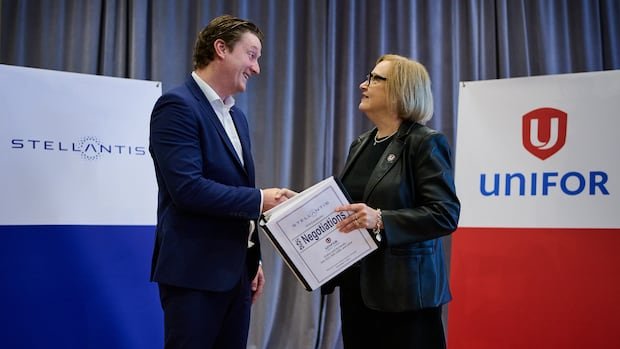

The labor union representing employees at Stellantis has cautioned the U.S. automaker against undervaluing its Canadian workforce as Unifor and the company initiated contract discussions on Tuesday. This negotiation phase signifies the final segment of Unifor’s talks with the Detroit Big Three automakers. Unifor typically employs a pattern bargaining strategy for its automotive sector negotiations, establishing terms it aims to replicate with other firms.
Although Unifor recently ratified fresh collective agreements with Ford Motor Co. and General Motors in Canada, the national president, Lana Payne, emphasized that the most significant challenge lies ahead. Payne acknowledged the obstacles faced due to uncertainties, tariffs, and trade disputes, expressing the expectation that the current negotiation round could be the toughest yet.
The parties are striving to reach a new agreement by a deadline set for September 11. The primary concern for the union revolves around job security following the layoff of over 2,000 workers from Stellantis’ Brampton, Ont., assembly plant, which has remained inactive since 2023.
Last month, the union received notification of Stellantis contemplating the closure and potential sale of the plant. The facility was initially planned for Jeep production, a process that commenced in early 2024 but was halted by the company in early 2025. Subsequently, the decision to shift Jeep Compass production to the U.S. was announced, which Unifor deemed a breach of the existing collective agreement, resulting in the indefinite idling of the plant.
Regarding this development, Payne reiterated the union’s discontent with the decision to relocate Jeep Compass production from the Brampton plant, labeling it as an erroneous choice. She emphasized the need for Stellantis to repair its relationship with members and Canadians, starting by reinstating work at the Brampton Assembly plant instead of considering closure or sale.
Stellantis emphasized the significance of labor discussions with the union for its future, acknowledging the industry’s evolving trade and regulatory landscape. The company’s chairman, president, and CEO, Trevor Longley, highlighted the substantial investments made across its Canadian operations since 2022 to enhance manufacturing capabilities and advance battery technology in Ontario.
Against the backdrop of U.S. tariffs impacting local automakers, Unifor stressed the necessity for Canada to maintain its automotive sector presence amid ongoing economic challenges. Payne emphasized the potential detrimental effects of escalating tariffs, urging Canada to stand firm against trade threats.
Larry Savage, a labor studies professor, highlighted Unifor’s dual challenges of negotiating with Stellantis to retain vehicle production in Canada while also advocating against trade agreements that could jeopardize the domestic auto industry. Unifor’s recent successful ratification of new contracts with General Motors reflected wage increases, mirroring the agreements reached with Ford to set the pattern for industry bargaining.