
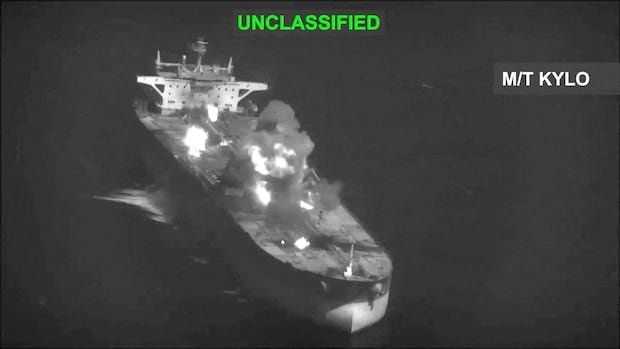

U.S. military forces launched attacks on three Iranian oil tankers in response to ballistic missile strikes on Navy warships, as announced by American officials on Saturday. The military warned of the possibility of destroying Iran’s vulnerable oil fleet if necessary, following a series of escalating conflicts at sea that had previously targeted commercial shipping.
The recent strikes mark a shift back to active combat after a period of intermittent hostilities that began with U.S. and Israeli assaults on Iran on February 28. Both sides have engaged in efforts to inflict military and economic damage, with failed negotiations exacerbating tensions.
According to the military statement, a U.S. aircraft carrier and destroyer successfully evaded multiple unprovoked Iranian attacks in the region, with no reported injuries to American personnel. The statement revealed that two Iranian oil tankers were rendered inoperable, while a third unladen tanker was destroyed, all of which were linked to supporting Iran’s Revolutionary Guard and its regional proxies.
Iran retaliated against the U.S. strikes by reportedly targeting three American vessels and three oil tankers, as claimed by Iran’s state broadcaster. Threats were issued by an Iranian military spokesperson warning of more severe actions against U.S. military ships should interference with Iranian shipping persist.
The U.S. Central Command emphasized its commitment to defending American forces and safeguarding interests, with Admiral Brad Cooper underscoring the readiness to eliminate Iran’s exposed oil fleet if required. In response, Iran’s Foreign Ministry condemned the attacks as war crimes, attributing the consequences of continued aggression to Washington and its allies.
The recent hostilities resumed following renewed economic pressure on Tehran by the U.S., amidst signals of Iranian government willingness for negotiations to end the conflict. Despite sanctions and port blockades, Iran has managed to maintain its oil exports through alternative means, including a network of covert oil transport vessels.
Efforts to address the core issue of Iran’s nuclear program through negotiations have faltered, leading to potential referral of Iran to the U.N. Security Council by the U.S., Britain, France, and Germany for noncompliance with nuclear nonproliferation agreements. With control over the vital Strait of Hormuz, a critical passage for global energy trade, Iran has heightened its strategic leverage amid the ongoing tensions.