

The forthcoming midterm elections represent a significant challenge for U.S. President Donald Trump and the party he has led for the last decade. Early indicators suggest that November may bring considerable losses for the Republicans.
Recent surveys indicate that the Democrats may be on the verge of substantial gains among voters who, just two years prior, would not have considered supporting the party.
A substantial portion of the American electorate seems to be losing faith in Trump, who came back into power vowing to reduce costs and avoid foreign conflicts but has instead overseen rising prices and a war with Iran during the initial two years of his second term.
Inflation rates are currently higher than they were in January 2025, when Trump began his second term. This is notable since his predecessor, Joe Biden, also faced a period of increased consumer prices.
Experts suggest that Trump’s tariffs have exacerbated affordability issues; without them, prices might have even decreased slightly, confirming the predictions of many economists.
Rising oil and diesel prices have surged partly due to the conflict in Iran and the ongoing situation in Ukraine, which Trump had promised to resolve within 24 hours of taking office but has struggled to alleviate.
Following some initial successes—such as curtailing the influx of migrants with his border policies and negotiating peace agreements—Trump’s approval ratings have plummeted.
One analyst noted that Trump is now the least popular Republican president since Herbert Hoover, who is often regarded by historians as ineffective due to his leadership during the Great Depression.
Asa McKercher, the Hudson Chair in Canada-U.S. Relations at the Brian Mulroney Institute of Government, commented, “These are historically low approval ratings, even lower than Richard Nixon’s during the Watergate scandal, which bodes poorly for Trump and his party.”
He added, “Trump is not only unpopular, but his policies have not yielded any positive results.”
This has led Trump to propose what McKercher refers to as “gimmicks,” such as $5,000 payments for every adult if Republicans maintain their power in the midterm elections.
McKercher remarked, “There’s a sense of desperation there.”
Some Republicans distancing themselves
Trump has consistently urged his supporters to “act as if I am on the ballot,” believing this will enhance Republican prospects in these congressional contests. However, some candidates from the party are attempting to distance themselves due to the president’s controversial reputation in specific circles.
Republican Senate candidate Mike Rogers from Michigan, who previously aligned closely with Trump, released a new campaign advertisement on Wednesday that criticized the president’s trade war with Canada.
Earlier this summer, Rogers claimed that Canadians “have not been good partners,” but that was before polls indicated a significant majority of Americans oppose tariffs against Canada. Politico’s findings revealed that only 26 percent of surveyed Americans support the Canadian tariffs.
In Maine, Republican incumbent Susan Collins, who is in a competitive Senate race, has voiced similar concerns regarding tariffs and has hinted she does not want Trump to campaign in her state.
During a debate on Tuesday, she remarked, “I’m not exactly his favourite senator.”
More Americans now identify as Democrat
One of the most telling recent data points is the significant shift in voter identification when Gallup pollsters ask respondents to choose between the two parties.
For most of the past four years, Republicans enjoyed a clear advantage.
Currently, however, the Democrats hold a double-digit lead as some voters have turned away from a party they expected would provide better economic outcomes, reduce inflation, and foster peace.
Mark Bednar, a former spokesperson for House Speaker Kevin McCarthy and now a Republican strategist, stated that all hope is not lost for the party—Trump remains highly popular among his MAGA supporters and has previously defied the odds.
However, he emphasized that the party must urgently address what he describes as the “enthusiasm gap,” where Democrats are significantly more motivated to vote than their Republican counterparts this year.
Bednar mentioned that there is one major advantage for the Republicans that could energize the electorate: a significant fundraising lead.
Trump alone possesses approximately $400 million in campaign funds that he can utilize in the final weeks of the campaign to saturate media with advertisements and support candidates in close races.
According to Bednar, “The Republicans have a substantial financial edge, allowing them to effectively communicate their message on television and present their narrative as Republicans, while also making a case against the Democrats.”
“As we approach these midterms, the competitiveness will increase in many of these races.”
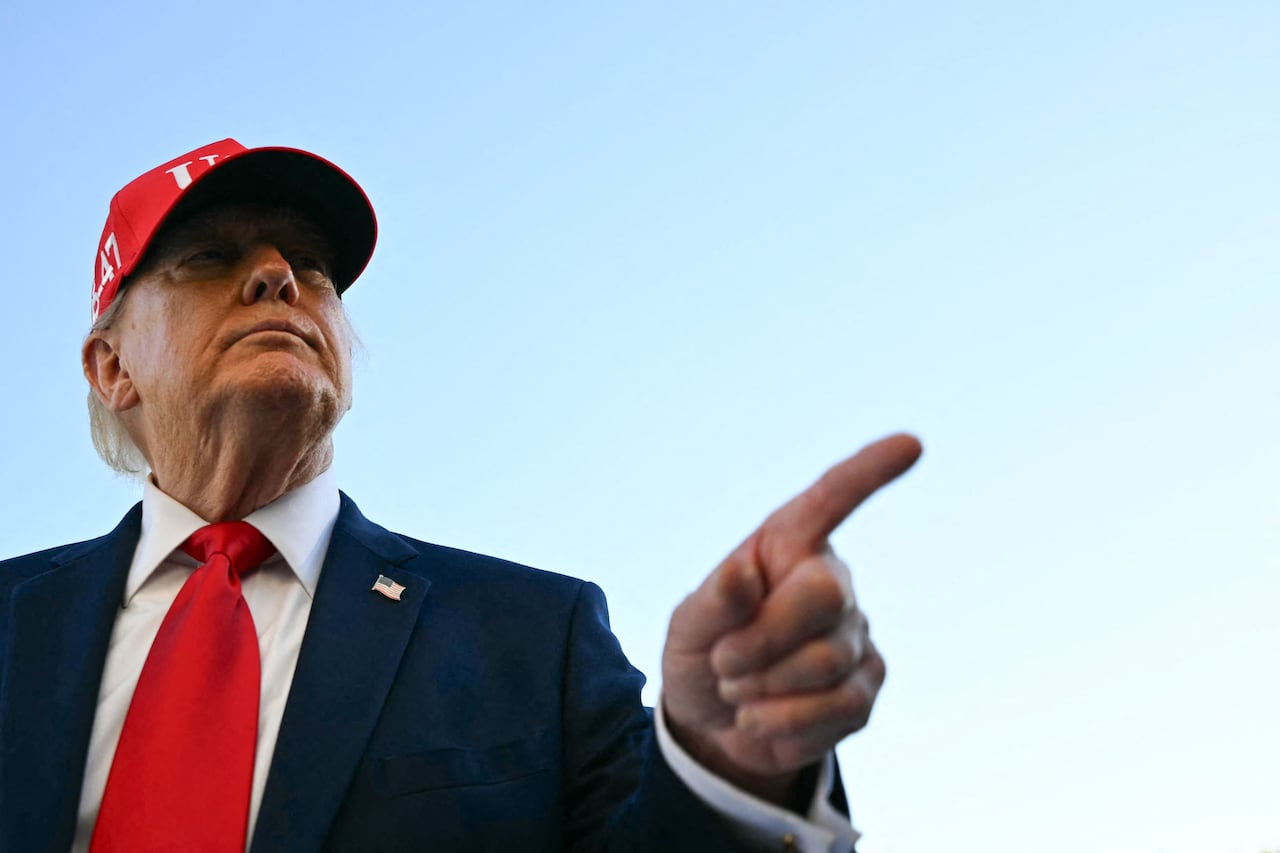
U.S. President Donald Trump speaks to the press at the White House. The Republicans have a huge financial advantage, which could help them close the polling gap with the Democrats. (Alex Wroblewski/AFP/Getty Images)
Reliably ‘red’ states in play, polls suggest
The upcoming midterm elections will determine who wields power in Washington.
Despite attempts by Republicans at the state level to draw district maps in their favor, polls indicate the party is set to lose control of the House of Representatives — the final outcome may be quite decisive even with their strategic map alterations—and potentially the Senate as well.
On the surface, the electoral landscape this year seems unfavorable for the Democrats, with numerous contests in traditionally Republican states. (Only one-third of Senate seats are contested every two years.)
However, the latest New York Times-Siena poll, which political analysts closely monitor for its accuracy, indicates that states previously considered “red” are now competitive.
For instance, Kansas hasn’t sent a Democrat to the Senate since 1932, yet the Siena poll (and others) suggest it may break that near-century-old pattern.
Agricultural producers, in particular, have suffered greatly from Trump’s trade war. Anyone reliant on tractors or combines for their products’ transportation has seen diesel prices double during Trump’s administration.
In Texas, a Republican stronghold where Trump defeated Democratic nominee Kamala Harris by nearly 14 percentage points in the last presidential election, new Siena data reveals that Democrat James Talarico has a six-point advantage over the struggling Republican Ken Paxton.
Polls illustrate why such a significant shift has occurred in this historically conservative state: Hispanic voters are moving away from the Republicans.
According to exit polls from the 2024 presidential election, 55 percent of Hispanics in Texas supported Trump. However, only 34 percent of Hispanics surveyed are inclined to support Paxton in this election, as per YouGov.
Approximately 64 percent of Hispanics express disapproval of Trump’s performance thus far.
This shift among Hispanic voters follows nearly two years of immigration raids that targeted many undocumented individuals, including some violent offenders, but also disrupted communities by removing long-standing residents.
Additionally, white voters in Texas are now reportedly more inclined to back Talarico, a moderate politician and Presbyterian seminarian with a strong social media presence, compared to their support for Harris two years ago.

Democratic U.S. Senate candidate James Talarico pictured in Dallas on Sept. 9. A new poll shows Talarico with a six-point lead over his Republican opponent in the race for the Senate. (Brandon Bell/Getty Images)
The economy, heavily affected by inflation, has altered the political landscape in other areas.
In Ohio, a state in the Rust Belt that has voted for Trump by significant margins in the past, Democrat Sherrod Brown is currently leading his Republican challenger by three percentage points in the Senate race, with Brown’s message being, “Life is too costly.”
During his recent campaign tour, Trump visited states including Ohio and Texas, as well as Alabama and Oklahoma. This strategy is unusual so close to election day, as parties normally concentrate their leaders’ efforts on critical swing states.
This indicates that the definition of a “swing state” has shifted considerably compared to previous elections.
McKercher commented, “This could be a perfect storm, where it’s not merely a blue wave but potentially a blue tsunami for the Democrats.”