
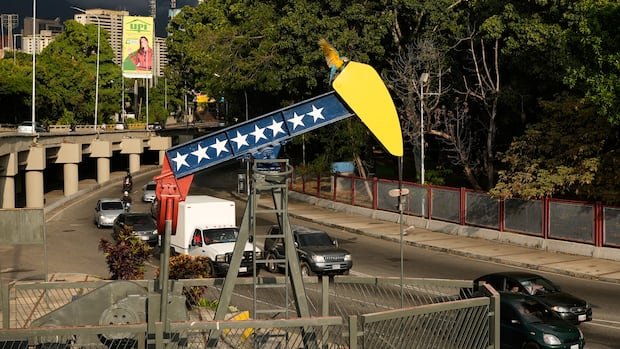

Following the recent apprehension of President Nicolás Maduro, U.S. President Donald Trump’s primary focus in Venezuela is clearly on the country’s oil reserves. Amid global interest in the White House’s forthcoming actions in the region, the significance of Venezuela’s oil assets can be illustrated through six informative charts.
Oil production in Venezuela has been on a downward trajectory since the mid-2000s, reaching its lowest point in 2020 due to stringent U.S. sanctions and reduced demand during the pandemic. Subsequently, there have been slight improvements in oil production.
Venezuela’s economic well-being is intricately linked to its oil sales. The country experienced a drastic economic downturn as oil production plummeted in the latter half of the 2010s, resulting in a contraction of approximately 30% in 2020. This decline was widely attributed to decades of mismanagement, insufficient investments, and U.S. sanctions.
Despite facing challenges in production, Venezuela boasts massive oil reserves, potentially surpassing those of Saudi Arabia, Iran, and Canada. However, it is estimated that a substantial investment of $180 billion over ten years would be necessary to restore production levels to those seen in the 1990s. Potential investors will need to navigate through political instability, aging infrastructure, and prevailing low oil prices.
Oil prices have been steadily declining, maintaining levels above $60 US for an extended period. With expectations of Venezuelan oil entering an already saturated market, prices could face further pressure. President Trump recently announced a deal where Venezuela is set to supply between 30 and 50 million barrels of oil at market prices, with sanctions selectively lifted to facilitate oil shipments globally.
The majority of Venezuela’s limited oil output is directed towards China, a key ally of the Maduro regime and a significant investor in the region. Venezuela is currently repaying a substantial debt of around $10 billion to China, partly through oil exports. U.S. Secretary of State Marco Rubio emphasized the U.S.’s stance following Maduro’s capture, highlighting the country’s commitment to preventing the Western Hemisphere from becoming a strategic base for U.S. adversaries, including China.
While the United States historically purchased a considerable share of Venezuela’s oil, accounting for approximately 23% in 2023, Venezuela’s status as a significant oil supplier to the U.S. has dwindled. Recent trade data indicates that no Venezuelan oil was imported to the U.S. in 2020 and 2021, with minimal shipments recorded in 2023 and 2024.
By: Professional News Content Writer