
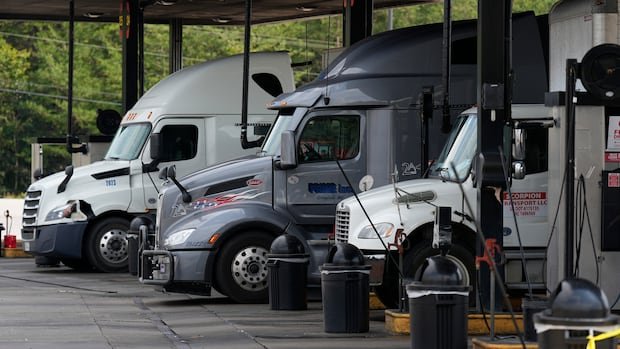

U.S. President Donald Trump has expressed interest in potentially halting diesel exports to help stabilize gas prices for American consumers, a decision that experts warn could further strain the already tight global market, leading to increased diesel costs in Canada and beyond.
During a meeting with Ukrainian President Volodymyr Zelenskyy at the UN General Assembly, Trump mentioned proposing a ban on diesel exports. He emphasized the significance of retaining the domestically produced diesel to impact regular gasoline prices slightly, especially with the looming midterm elections and rising gas prices.
Despite initial discussions, U.S. Treasury Secretary Scott Bessent indicated that Washington is evaluating the feasibility and potential impact of a complete or partial ban on diesel exports. However, a White House official refuted claims of actively preparing a 90-day ban on diesel exports, and U.S. Energy Secretary Chris Wright clarified that a total ban is not under consideration.
The proposal emerges amidst soaring diesel prices due to geopolitical tensions in Iran and Ukraine. In Canada, diesel prices have exceeded $2 per liter for the past 12 weeks, reaching $2.66 per liter, up over a dollar from the previous year. Similarly, diesel prices in the U.S. have surged to over $6.50 per gallon, compared to $3.69 per gallon around the same time last year.
Experts caution that an embargo on U.S. diesel exports would disrupt the global market significantly. Joe Calnan, VP of energy at the Canadian Global Affairs Institute, criticized the proposal as shortsighted and likely to amplify price volatility worldwide. The U.S. exports approximately 1.5 million barrels of diesel daily, primarily to Latin America and Western Europe, and any sudden removal from the market would trigger widespread price hikes.
Wood Mackenzie’s report highlighted Europe’s vulnerability to a U.S. diesel export ban, given its increasing reliance on American diesel exports, which surged to 50% in September, up from the 30% average in 2025.
In Canada, the potential global price hike would exacerbate existing challenges, particularly affecting the transportation and agriculture sectors heavily reliant on diesel. With farmers currently facing increased costs during harvest season, any additional price pressure on diesel could have far-reaching consequences across various regions in the country, impacting not only transportation but also power generation and heating.
Although Canada is a net exporter of diesel, experts stress that a U.S. export ban would have pricing implications. Carol Montreuil, VP at the Canadian Fuels Association, emphasized that while Canada could manage without U.S. diesel imports due to its surplus production, the pricing dynamics would change significantly.
The surge in diesel prices is primarily attributed to conflicts in Iran and Ukraine, disrupting global supply chains and refining capacities. The ongoing tensions have severely impacted the movement of vessels through key shipping routes like the Strait of Hormuz and the Bab el-Mandeb Strait, contributing to supply constraints and price spikes in the diesel market.
While retaining U.S. diesel domestically may initially alleviate gas prices for Americans, experts warn of potential price repercussions in the long run. Patrick De Haan, head of petroleum analysis at Gas Buddy, highlighted that the shift would require adjustments in refinery operations to prevent oversupply, affecting both diesel and gasoline prices. The uncertainty surrounding U.S. refinery operations underscores the complexities and potential ramifications of such a policy decision.