
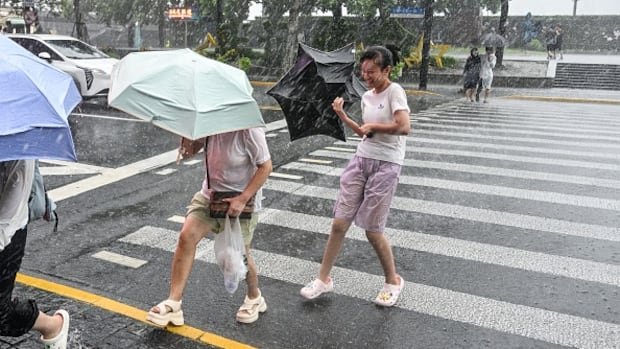

Shanghai’s airports faced significant disruptions on Monday due to tropical storm Dolphin unleashing heavy rain in eastern China. The storm, which had earlier made landfall as a typhoon, caused widespread flight cancellations. Shanghai’s Hongqiao and Pudong airports canceled over 900 flights, representing about 40% of the scheduled flights. This came after approximately 1,300 flights were already canceled the previous day, as reported by the Shanghai Airport Group. In addition to flight disruptions, Shanghai suspended some metro lines, and China Railway Chengdu Group halted 115 trains. Authorities issued warnings about potential severe flooding and landslides in certain regions, with efforts underway to rescue individuals trapped in flooded homes in Zhejiang province’s Yueqing city.
The China Meteorological Administration stated that Dolphin was moving northwest at a speed of 15 to 20 kilometers per hour and was anticipated to weaken further. After hitting Taizhou, Zhejiang province, on Sunday evening with winds reaching 151 kilometers per hour, Dolphin brought heavy rainfall to northern Taiwan. The storm’s impact was evident in Zhejiang’s Wenzhou, where a viral TikTok video showed a truck overturning amidst powerful winds and rain. Dolphin prompted the preemptive relocation of at least 760,000 individuals, including large-scale evacuations in Taizhou, Shanghai, and Fujian province.
Authorities in Hangzhou, the capital of Zhejiang, closed several tourist attractions temporarily, including West Lake, temples, parks, and museums. Meanwhile, another tropical storm, Chan-hom, was on course to approach Japan’s Pacific coast, with forecasts predicting a slight strengthening before its expected landfall. In Shanghai, live streams shared on social media showed waterlogged streets in suburban districts, with residents navigating through knee-high murky water. The city’s authorities advised non-essential businesses to suspend operations temporarily due to the forecast of continued adverse weather conditions.
As Dolphin continued its path, Beijing braced for significant rainfall, prompting the city to prepare for potential flood control measures. Weather officials warned of flash floods in the city and potential landslides in nearby mountainous areas. Dolphin’s extensive journey before landfall and the resulting large cloud system engulfing China’s eastern regions drew comparisons to the 2023 typhoon Doksuri. The impact of Dolphin extended to the Philippines, intensifying seasonal monsoon rains and triggering landslides and flooding in the Luzon region, claiming lives and displacing thousands of residents. Hong Kong experienced record-breaking temperatures due to the storm, with extreme heat recorded.
The ongoing active northwest Pacific typhoon season, fueled by a strong El Niño event and other atmospheric conditions, was expected to see heightened tropical activity. Dolphin’s indirect impact on the Philippines underscored the widespread influence of such weather systems, emphasizing the need for vigilance and preparedness in vulnerable areas.