
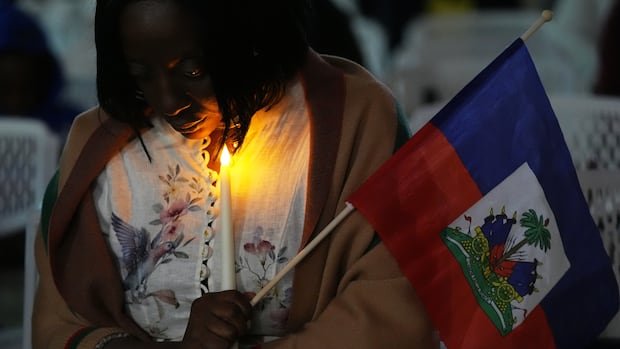

The U.S. Supreme Court engaged in discussions on Wednesday regarding the legality of an action taken by the Trump administration to cancel temporary legal protections for hundreds of thousands of U.S. residents from two countries. This move is part of the Republican president’s agenda to deport a large number of individuals.
The ongoing case involves legal challenges brought forward on behalf of Haitian and Syrian migrants. A ruling favoring the Trump administration could have significant implications for 1.3 million immigrants from 17 specified countries who have been granted Temporary Protected Status (TPS). Furthermore, it could impact the flow of migrants to Canada.
Representing the Trump administration, U.S. Solicitor General D. John Sauer argued that the lawsuits contesting the revocation of TPS lack merit and are prohibited by federal law. Sauer mentioned that these lawsuits challenge the type of foreign policy decisions typically left to the political branches.
Under the Immigration Act of 1990, the TPS designation is offered to individuals from countries experiencing natural disasters, armed conflicts, or other extraordinary events that make it unsafe for them to remain or return. TPS recipients, some of whom have resided in the U.S. for years and face potential separation from their jobs and families, argue that it is inhumane to send them back to countries where they could encounter danger, including violence and death.
Currently, the State Department advises against travel to Haiti and Syria due to concerns such as widespread violence, crime, terrorism, and kidnapping. In a tragic incident, four Haitian women who were deported from Puerto Rico were found beheaded and discarded in a river.
Justice Sonia Sotomayor, one of the liberal justices, contended that the administration’s stance contradicts the relevant federal statute and the U.S. Constitution. She emphasized that TPS recipients, until the termination, are lawfully present with permission and entitled to due process.
Many Haitians were granted TPS status in 2010 following a devastating earthquake in their country. The U.S. government has extended this status multiple times, including under President Joe Biden.
The protections for Syrians were initially granted in 2012 during a prolonged civil war that ended with the fall of President Bashar al-Assad’s government in late 2024.
Syrian and Haitian TPS holders filed class-action lawsuits alleging that the termination notices were a pretext to end existing designations. They argued that the Homeland Security secretary did not adhere to the TPS law’s procedural requirements for consulting other federal agencies about conditions in the affected countries before revoking protective status.
The Trump administration maintained that the courts should not question whether government agencies engaged in adequate consultation before terminating TPS. Conservative Justice Samuel Alito expressed support for this argument, stating that procedural objections could always be raised.
Preceding the oral arguments, a White House spokesperson emphasized that TPS was not intended as a pathway to permanent residency, despite calls from certain organizations.
In the case involving Haitians, a U.S. District Judge in Washington suggested that the administration’s actions may have been partly motivated by racial bias, potentially violating the Constitution’s promise of equal protection under the law.
Under Trump’s administration, the Department of Homeland Security moved to end TPS status for residents from 13 countries and encouraged non-citizens to self-deport. The administration also deported individuals to countries where they lacked ties, deviating from the non-refoulement principle under international law.
Trump’s attempts to rescind TPS protections during his first term were unsuccessful, but he indicated intentions to try again during his 2024 campaign. Notably, he made disparaging and false remarks about Haitian immigrants, leading to security concerns in certain areas.
The Supreme Court, which leans conservative with three justices appointed by Trump, is anticipated to release its ruling on this case in late June or early July.