
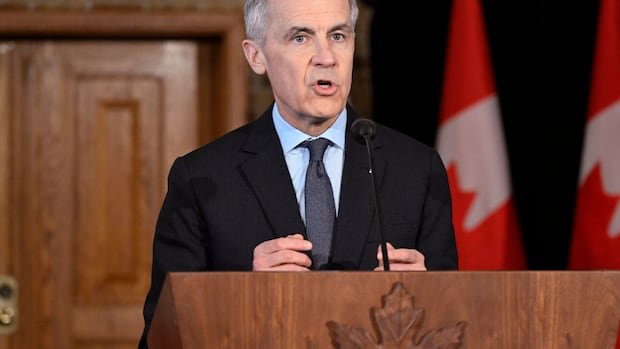

Prime Minister Mark Carney had a busy week engaging in global diplomacy and leading key cabinet discussions, but uncertainty loomed over future plans as a scheduled press briefing was abruptly canceled, citing the prime minister’s tight schedule.
Carney, who had refrained from media interactions following his overseas trips to China, Qatar, and Davos, Switzerland, and his vocal criticisms of U.S. President Donald Trump, faced mounting inquiries about the status of the strained Canada-U.S. relationship and its implications for trade talks.
During a two-day cabinet meeting at the Citadelle in Quebec City, Carney rebuffed Trump’s assertion that Canada owes its existence to the United States, emphasizing Canada’s independent strength. This marked his second significant address of the week, following his well-received speech in Davos where he denounced countries weaponizing economic ties.
In a surprising turn of events, Trump rescinded Carney’s invitation to join his “Board of Peace” initiative for Gaza and made unfounded claims about NATO allies during the Afghanistan conflict. While Carney remained silent, Finance Minister François-Philippe Champagne defended Canada’s military history and dismissed attempts to distort facts.
Carney called for unity and emphasized Canadian values as crucial for safeguarding sovereignty amidst potential separatist movements in Alberta and Quebec. He urged Canada to serve as a beacon of democracy in the face of growing authoritarianism, highlighting the country’s unique history of cooperation and partnership.
Criticism arose in Quebec over Carney’s historical narrative, with Parti Québécois Leader Paul St-Pierre Plamondon accusing him of distorting facts amid separatist sentiments. Meanwhile, Conservative Leader Pierre Poilievre questioned the Liberal government’s efforts to reduce reliance on the U.S., emphasizing the need for concrete actions to protect Canadian jobs and strengthen trade partnerships.
As the House of Commons prepares to reconvene after a hiatus, the closed-door cabinet discussions centered on economic issues, affordability, security, and artificial intelligence, setting the stage for upcoming legislative priorities.