
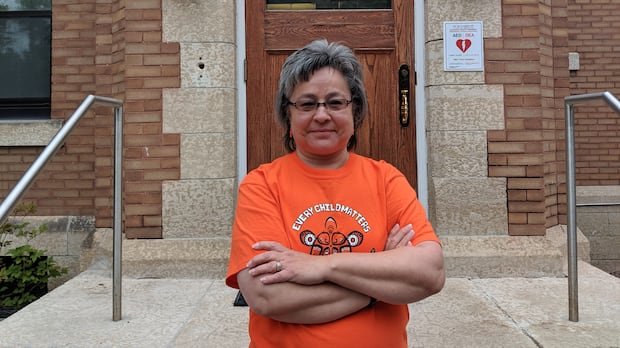

The individual who initiated Orange Shirt Day expressed dismay upon discovering orange shirts emblazoned with phrases like “Dig deeper” and “Still no proof” being marketed online. Phyllis Webstad, sharing her sentiments from Tk̓emlúps te Secwépemc in B.C. following the revelation of potential unmarked graves near a former residential school site in 2021, stated that her cause was being misused in a negative manner.
Webstad recounted her personal experience of wearing an orange shirt given by her grandmother on her first day at a residential school in 1976, only for it to be confiscated and never returned by school authorities. In remembrance of Indigenous children compelled to attend residential schools, she established Orange Shirt Day 13 years ago on Sept. 30.
Recently, Rebel News announced the sale of orange T-shirts featuring various statements such as “Still no proof,” “You can’t handle the truth,” and “Canada was built not stolen,” in connection with the National Day for Truth and Reconciliation. Webstad criticized this initiative as a direct affront to her efforts with the Orange Shirt Society, emphasizing the importance of respecting and acknowledging her truth.
In response to the backlash, Ezra Levant, founder of Rebel News, defended the T-shirt sales by highlighting their commitment to freedom of expression and the right to pursue truth. The controversy surrounding the shirts led to condemnation from MPs and ministers, with the Liberal Indigenous Caucus denouncing the merchandise as disrespectful to survivors and their narratives.
Indigenous Services Minister Mandy Gull-Masty, drawing from her family’s history at La Tuque Indian Residential School in Quebec, voiced her condemnation of the shirts and expressed the public’s outrage over the exploitation of human suffering for profit. Concerns were raised to Justice Minister Sean Fraser, indicating a need for governmental action to address such behavior.
Moreover, academic perspectives, like that of Sean Carleton from the University of Manitoba, criticized the shirts for commercializing anti-Indigenous sentiment and undermining efforts towards truth, healing, and reconciliation. The deliberate inclusion of youth sizes was seen as a tactic to incite conflicts within educational settings and challenge established policies.
As discussions continue on the implications of residential school denialism, efforts are being made to address the issue at both governmental and societal levels. Calls for legislative measures to combat denialism and promote understanding and respect for Indigenous experiences are gaining momentum among various stakeholders.