
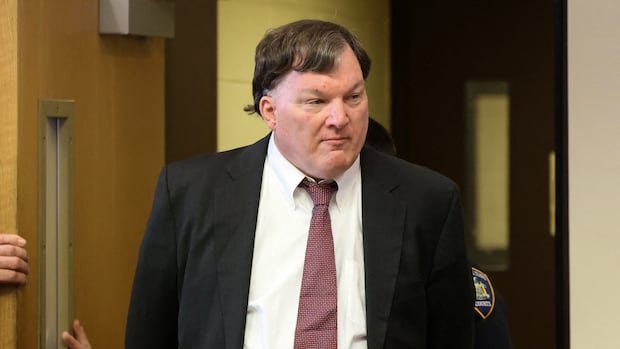

A New York City-based designer who lived a double life as a serial killer has confessed to the murder of seven women and acknowledged killing an eighth in a series of long-unresolved cases known as the Gilgo Beach homicides. Rex Heuermann, aged 62, made the admissions in a crowded courtroom with journalists and families of the victims present, some of whom were moved to tears as he recounted his crimes.
Heuermann’s admissions, including three charges of first-degree murder and four of intentional murder, mark the conclusion of a perplexing case that had confounded investigators, distressed the victims’ families, and captivated true-crime enthusiasts online for years. During questioning by Suffolk County district attorney Ray Tierney, Heuermann disclosed that he had strangled all eight victims, dismembered some of them, used disposable phones to communicate with them, and wrapped their bodies in burlap before discarding them.
Appearing composed and detached in a black suit coat and white shirt, Heuermann responded matter-of-factly to inquiries from Tierney and the judge without glancing at the courtroom audience, which was filled to capacity. He is now facing a life sentence and is scheduled for sentencing in June.
The investigation into the Gilgo Beach killings commenced in late 2010 after law enforcement discovered multiple sets of human remains along a desolate beach highway on Long Island’s South Shore. The search for Shannan Gilbert, a sex worker whose demise at Gilgo Beach was initially ruled an accidental drowning by Suffolk County officials, triggered the discovery of those remains. Despite the official ruling, Gilbert’s family contested this conclusion, with Heuermann’s defense counsel, Michael Brown, asserting that his client was not involved in Gilbert’s case.
Through DNA analysis and other evidence, investigators managed to identify the victims and link some of them to remains found elsewhere on Long Island years earlier. The bodies of six victims were found near Gilgo Beach, while another victim’s remains were located over 100 kilometers away in the Hamptons. Heuermann admitted guilt in these killings, as well as confessing to relocating the body of Karen Vergata, whose remains were found in two separate locations several kilometers apart and 15 years apart.
The disappearances of these individuals have been the focal point of various true-crime programs and documentaries. Following the formation of the Gilgo Beach task force by a new police commissioner in 2022, detectives identified Heuermann as a suspect by linking him to a pickup truck seen by a witness during one of the victims’ disappearance in 2010 through a vehicle registration database.
After the vehicle discovery, a grand jury issued over 300 subpoenas and search warrants, enabling the task force to delve into Heuermann’s activities. Detectives scrutinized billing records for disposable phones used for victim meetings, retested DNA evidence found with the bodies, and examined Heuermann’s internet search history, which revealed his interest in violent content and the Gilgo Beach cases. Surveillance teams collected Heuermann’s DNA by trailing him to his workplace and obtaining DNA from discarded pizza crusts, which ultimately matched hair found on burlap used to restrain a victim.
Following his arrest in July 2023, investigators uncovered a cache of 279 weapons in Heuermann’s home, along with a computer containing what they described as a blueprint for the killings. Despite Heuermann’s attempt to exclude DNA evidence during his defense, a judge rejected this request last year, making his case more challenging. Heuermann’s attorney mentioned that his client’s primary concern was sparing the victims’ families and his own from the trial’s anguish.
As part of his guilty plea, Heuermann agreed to cooperate fully with the FBI’s behavioral analysis unit.