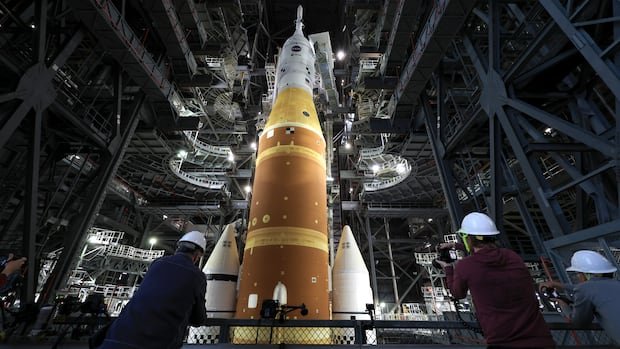

NASA’s Artemis II mission, initially scheduled for launch on February 8, has been postponed by at least a month due to a hydrogen leak discovered during fueling. The first Artemis mission also encountered delays related to fuel leaks.
Liquid hydrogen and liquid oxygen, key components of rocket fuel, have unique properties due to their extremely cold temperatures. Liquid hydrogen, with a boiling point of -253 C, is colder than liquid oxygen, which boils at -183 C. The challenge lies in maintaining these cryogenic liquids in a liquid state despite the hot Florida climate where the rockets are launched.
To prevent the fuels from vaporizing prematurely, the Space Launch System (SLS) rocket’s core stage is insulated with orange foam to shield the cold fuel from the warm air. Special precautions, such as pre-chilling fuel lines and tanks, are taken to avoid leaks caused by the extreme temperature differences.
Despite these measures, leaks are common due to the combination of ultra-cold temperatures and vapor pressure. Hydrogen, being the smallest molecule, is prone to escaping through tiny openings, leading to potential leaks in pipelines and valves. The recent delay was caused by a leak at the connector between the launch tower hose and the rocket, similar to an issue faced during the Artemis I flight.
Efforts are underway to address the leak without returning the rocket to the Vehicle Assembly Building, aiming for a launch no earlier than March 6 following another wet dress rehearsal. While hydrogen leaks have been a persistent challenge for NASA, private companies like SpaceX have opted for kerosene or methane fuels for easier handling.
The use of liquid hydrogen and oxygen in the SLS rocket traces back to space shuttle technology from the 1970s, offering high thrust-to-weight ratio ideal for heavy lift vehicles. However, critics argue that the SLS is costly and non-reusable compared to modern rockets used by private companies. Balancing technology improvements to mitigate leaks with cost-effectiveness is crucial for the future of the SLS rocket.