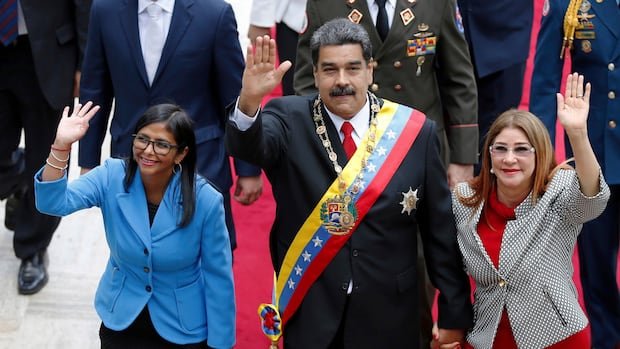

Hours after a bold military operation by the U.S. removed Venezuelan leader Nicolás Maduro from power and took him out of the country on Saturday, his vice-president demanded Maduro’s release, affirming him as the rightful leader of Venezuela. Early on Saturday, Caracas experienced multiple explosions and sightings of low-flying aircraft. The Maduro government accused the U.S. of attacking both civilian and military sites, labeling it an “imperialist attack” and calling on citizens to protest. Maduro and his wife were apprehended from their home on a military base and transported to a U.S. warship before being flown to New York City to face charges related to a narco-terrorism conspiracy.
Vice-President Delcy Rodriguez reported casualties among Venezuelan civilians and military personnel. According to Venezuelan law, Rodriguez would assume the presidency in Maduro’s absence, but she clarified during a televised appearance on Saturday that she had no intentions of taking over. Instead, Rodriguez demanded Maduro’s release and declared him the legitimate president of Venezuela.
In response to claims by Trump that Rodriguez had been sworn in as president and had expressed willingness to cooperate with the U.S., Rodriguez did not confirm any political transition during her televised address. She denounced the actions against Venezuela as violations of international law and expressed no inclination towards collaboration with the U.S. administration.
Opposition leader Maria Corina Machado suggested that opposition candidate Edmundo Gonzalez, who she claimed won the 2024 presidential election, should assume power. The Venezuelan constitution stipulates that a new election must be held within a month in case of the president’s absence, leading to debates among experts on whether this succession provision applied given the circumstances of the government’s legitimacy and the unprecedented U.S. military intervention.
Trump asserted that the U.S. would participate in governing Venezuela, emphasizing a smooth and secure transition. Despite his statements, there were no immediate indications of U.S. involvement in Venezuela’s administration. The military operation marked the culmination of a sustained pressure campaign by the Trump administration on Venezuela and was the most forceful American action to effect regime change since the 2003 Iraq invasion. The legal justification for the operation was not immediately clear, although the Trump administration justified it as essential to combat drug trafficking. Trump also hinted at plans to enhance the country’s oil infrastructure and boost oil exports to other nations.