
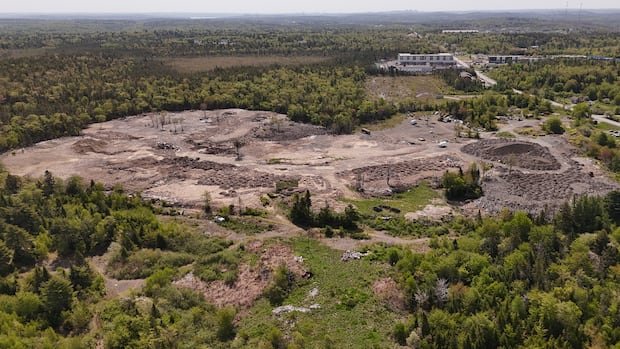

A vast, desolate 10-hectare plot of land near Halifax, covered in rock, dirt piles, and a few sparse trees, is a stark contrast to the surrounding residential area. This unusual site is now at the center of a legal dispute utilizing legislation typically reserved for targeting drug trafficking and organized crime activities.
Government authorities in Nova Scotia are employing the long-standing Civil Forfeiture Act to pursue the confiscation of equipment allegedly used in an illicit landfill operation conducted last year in Upper Hammonds Plains, N.S. This case represents a rare instance where the province’s civil forfeiture law, in place for nearly two decades, is invoked following an investigation into environmental law violations, sparking controversy.
The owner of one of the seized pieces of equipment, Arni Lively of Dennis Lively Construction, is expressing frustration, vehemently denying any involvement in the alleged illegal dumping. He contends that his excavation company was merely leasing land at the location and has been unfairly entangled in the investigation.
Lively passionately asserts that the province’s Environment Department unjustly confiscated his $300,000 topsoil sifting machine, the Powerscreen Warrior 800, disrupting his business operations and causing employees to lose work. The equipment, along with a backhoe and excavator not owned by Lively, was removed in January following an inquiry into the property off Pockwock Road.
According to court records filed recently as part of the forfeiture application, the Justice Department alleges that drone footage from June 2025 captured trucks depositing construction debris and litter on the property. The documents claim that Franklyn Whiley, the landowner, was seen accepting cash and using an excavator to bury the waste, while the Powerscreen was reportedly involved in processing the material.
While the legal proceedings are ongoing, charges under the Environment Act and waste regulations are being considered by investigators, although none have been formally filed yet. The Environment Department has not released the drone footage or provided comments on the case. Whiley, the owner of the equipment facing forfeiture, has refrained from public statements due to legal advice but granted limited access to the property for observation.
The application of the Civil Forfeiture Act in this environmental context is considered unusual by legal experts, with Jeff Simser, a former civil forfeiture director in Ontario, noting that the legislation was designed to encompass a variety of non-criminal activities, including unauthorized landfill operations. The focus is on seizing proceeds or instruments of unlawful activities to prevent their further use.
Lively maintains that he was unaware of any illegal dumping on the property, emphasizing that his company was using the land for storing soil excavated during a nearby housing development project. He highlights the significance of producing clean topsoil for his business and the financial impact of losing the Powerscreen equipment.
The Justice Department asserts that the seized equipment was utilized in activities violating environmental laws, justifying its designation as instruments of unlawful conduct under the Civil Forfeiture Act. The department declined interview requests due to the ongoing legal proceedings, indicating that this case is a unique instance referred by the Environment Department in recent years.