
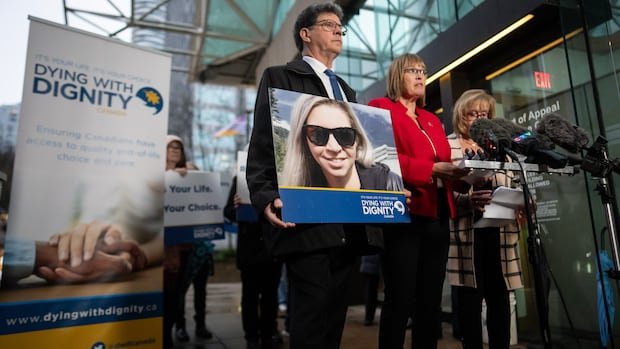

A current case in the B.C. Supreme Court is challenging the policy that permits faith-based health-care providers to refuse medical assistance in dying on their premises. Advocates are seeking to invalidate the policy to avoid forcing patients to relocate at the end of their lives. If the case proceeds to the Supreme Court of Canada, it could have significant implications nationwide.
The number of individuals receiving medical assistance in dying (MAID) in Canada is on the rise. In 2024, 16,499 patients received MAID, compared to 9,950 in 2021, amounting to 5.1% of all deaths in Canada that year.
Transfers for MAID can occur for various reasons, including patients wishing to move from a hospital to pass away at home. Health Canada data from annual reports indicate that in 2023, almost half of MAID transfers were influenced by the facility’s policy, decreasing to a quarter in 2024. Data for 2021 and 2022 is unavailable.
The ongoing trial in B.C. reveals that around one-third of MAID-related transfers in 2024 were connected to the facility’s policy. However, Health Canada data shows that such transfers are more common in other provinces, particularly Manitoba (77%) and Alberta (74%). In contrast, transfers are less frequent in the territories, P.E.I., Newfoundland, and Quebec, where faith-based facilities are mandated to permit MAID.
Various provinces in Canada have diverse approaches regarding MAID in faith-based institutions. Some provinces like B.C., Alberta, Manitoba, New Brunswick, Newfoundland and Labrador require these facilities to provide information about MAID but are not obligated to offer it on-site. Saskatchewan and Ontario leave the decision to individual institutions. Quebec mandates MAID provision in certain care facilities, irrespective of their faith-based status.
Nova Scotia’s stance on MAID in faith-based institutions remains uncertain, though at least one faith-based hospital in the province has a designated area for administering MAID. P.E.I. and Yukon lack faith-based end-of-life care facilities, while information is lacking for the Northwest Territories and Nunavut.
Allowing MAID in faith-based facilities would not compel staff who disagree with the practice to participate. Instead, only willing and qualified practitioners would engage in MAID procedures in buildings owned or leased by faith-based organizations.