
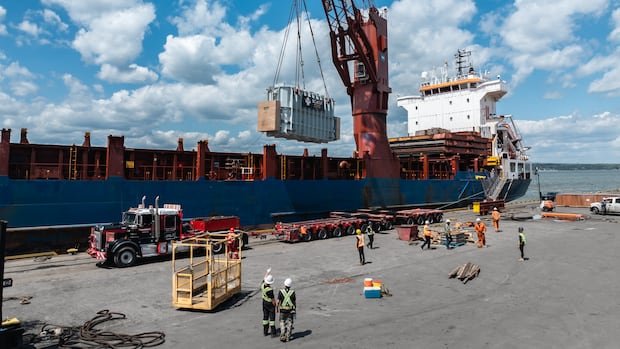

Political and business leaders are advocating for increased cargo transportation on the Great Lakes, with an expert suggesting that transitioning freight from roads to waterways could alleviate truck congestion and reduce emissions. However, significant investments from governments and industry are necessary to make this shift possible.
At the recent meeting of the Great Lakes and St. Lawrence Cities Initiative in Hamilton, municipal leaders from Canada and the United States explored the potential of marine shipping on the Great Lakes. Jonathan Altenberg, the president and CEO of the Great Lakes and St. Lawrence Cities Initiative, emphasized that the St. Lawrence River has the capacity to handle more freight than it currently does.
Hamilton, as part of the “Fresh Coast Economic Corridor,” is a key player in the third-largest economic region globally, generating $9 trillion USD in economic activity, according to Mayor Andrea Horwath. Collaborating with stakeholders in the area could help ease congestion on highways like the QEW and Highway 403 by transferring cargo from trucks to ships.
Elkafi Hassini, associate dean of research at McMaster University’s DeGroote School of Business, affirmed that marine transport is advantageous for bulk goods like steel, grain, and sugar. He highlighted that a single vessel can transport the equivalent of hundreds of truckloads, potentially reducing significant freight traffic on highways.
While marine shipping offers environmental benefits by being cost-effective and emission-reducing, Hassini and Ian Borsuk of Environment Hamilton acknowledged practical challenges. Companies often prioritize transportation modes based on cost, reliability, and speed, with road shipping being more flexible for last-mile deliveries.
Hassini envisions Hamilton becoming a logistics hub due to its strategic location, port facilities, and proximity to major urban centers. However, realizing this potential would require substantial investments in terminals, coordinated shipping schedules, and infrastructure improvements.
Environmental groups cautiously support the shift towards marine shipping to reduce truck traffic, acknowledging the need to balance environmental concerns with economic growth. Borsuk emphasized the importance of sustainable transportation methods to mitigate pollution and protect water sources like Lake Ontario.
Hassini emphasized that transitioning to marine freight will be a gradual process, requiring collaboration among governments, ports, and private entities. As congestion in the Greater Toronto and Hamilton Area continues to grow, exploring alternative transportation options becomes increasingly imperative.