
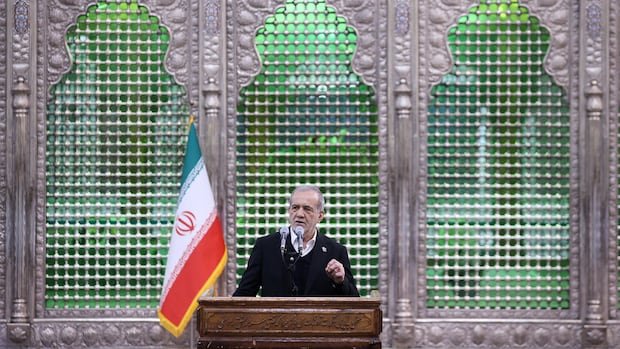

Iran’s president announced on Tuesday that he has directed the country’s foreign minister to engage in negotiations with the United States, signaling Tehran’s willingness to pursue talks amidst ongoing tensions following the violent suppression of nationwide protests. This shift in stance by reformist President Masoud Pezeshkian, who had previously expressed concerns about the situation spiraling out of control, indicates backing from Iran’s Supreme Leader Ayatollah Ali Khamenei for dialogue that he had previously dismissed.
Efforts are being made by Turkey to facilitate the potential talks later in the week, coinciding with the visit of U.S. Mideast envoy Steve Witkoff to the region. Foreign ministers from Oman, Pakistan, Qatar, Saudi Arabia, and the United Arab Emirates have been invited to participate in the discussions if they materialize, as per a regional official speaking anonymously.
The prospect of reaching an agreement between Iran and the U.S. remains uncertain, especially as President Donald Trump has now included Iran’s nuclear program as a key demand in any negotiations. Trump had previously ordered the bombing of three Iranian nuclear sites during a conflict with Iran in June 2025.
President Pezeshkian communicated his decision to pursue negotiations in a statement posted in English and Farsi, citing requests from regional allies and the U.S. for dialogue. Emphasizing the need for a conducive and respectful environment, he instructed the Foreign Minister to engage in fair and balanced negotiations guided by principles of dignity and prudence.
While the U.S. has not confirmed the talks, a report from an Iranian news agency mentioned an order from Pezeshkian to Foreign Minister Abbas Araghchi, who had engaged in discussions with Witkoff prior to the conflict. The discussions, if held, are expected to focus primarily on nuclear issues, according to Ali Shamkhani, a top adviser to Khamenei on security, who hinted at the possibility of indirect talks initially with a potential shift to direct negotiations.
Shamkhani dismissed the idea of Russia taking Iran’s enriched uranium, asserting Iran’s commitment to not pursuing nuclear weapons. Iran’s enrichment activities had reached 60% purity, close to weapon-grade levels, raising concerns and calls for inspection by the International Atomic Energy Agency (IAEA). However, Iran has resisted IAEA inspections of the sites targeted during the conflict.
In related developments, Witkoff is set to meet with Israeli officials to discuss the situation, with Israel likely to push for stringent measures in any potential agreement with Iran, including the removal of enriched uranium, cessation of enrichment activities, restrictions on ballistic missile development, and an end to support for Iranian proxies. The issue of uranium enrichment remains a contentious point, with Iran’s stance reflecting past obstacles in negotiations with the U.S.