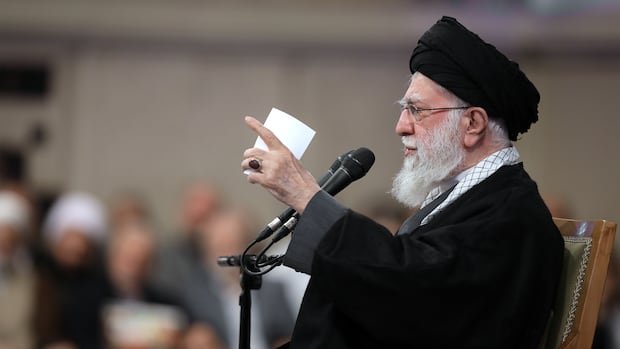

Iran’s supreme leader emphasized on Saturday the need to control “rioters” following a series of protests that have unsettled the Islamic Republic, potentially authorizing security forces to forcefully suppress the unrest.
Ayatollah Ali Khamenei, aged 86, made his first remarks amidst the violence stemming from protests triggered by Iran’s struggling economy, resulting in the death of at least 10 individuals. The demonstrations, which continue unabated, were provoked further by U.S. President Donald Trump’s warning that the U.S. would intervene if Iran resorts to violent measures against peaceful protesters.
While the extent of Trump’s potential intervention remains uncertain, his statements elicited a swift and enraged reaction from officials in Iran, who threatened to target American forces in the Middle East. These developments gained significance after Trump claimed on Saturday that the U.S. military had apprehended Venezuelan President Nicolás Maduro, a long-time ally of Tehran.
The ongoing protests mark the largest wave of demonstrations in Iran since 2022, triggered by the death of Mahsa Amini, a 22-year-old woman who died in police custody. However, the current protests have not reached the same scale and intensity as those following Amini’s demise, which was linked to her refusal to comply with the mandatory hijab regulation.
During a televised address to an audience in Tehran, Khamenei attempted to distinguish between legitimate protesters voicing concerns over the plummeting value of the rial and the disruptive “rioters.”
“We engage in dialogue with protesters, but there is no justification for engaging with rioters. Rioters must be subdued,” stated Khamenei. He reiterated the common narrative in Iran that external forces, such as the U.S. and Israel, were instigating the protests and blamed these influences for the devaluation of Iran’s currency.
The Iranian Revolutionary Guards, including the volunteer Basij force, are known for their aggressive suppression of protests, as witnessed during the Green Movement in 2009 and the 2022 demonstrations. These forces report directly to Khamenei.
While President Masoud Pezeshkian has advocated for dialogue to address the protesters’ grievances, hardline elements within Iran are pushing for a more forceful response to the protests. Past protests against issues like a fuel price hike in 2019 and the Amini demonstrations in 2022 resulted in severe crackdowns, leading to numerous casualties and detentions.
According to the Eurasia Group, Iran lacks a structured domestic opposition, suggesting that the current protests are likely spontaneous. Despite the potential for further protests due to the country’s precarious economic situation, the regime possesses a formidable security apparatus to quell dissent without losing control.
The recent protests have spread across more than 100 locations in 22 provinces of Iran, driven primarily by economic grievances. Demonstrators have not only criticized Iran’s economic policies but have also expressed dissent against the prevailing theocratic regime. Iran’s attempts to revive its economy post the conflict with Israel in June, where U.S. airstrikes targeted Iranian nuclear facilities, have been largely unsuccessful.
In a bid to signal openness to potential negotiations and ease sanctions, Iran announced a halt to uranium enrichment at all domestic sites. However, talks on this matter are yet to materialize, with both Trump and Israeli Prime Minister Benjamin Netanyahu cautioning Iran against reviving its nuclear program.
(Word count: 553)