
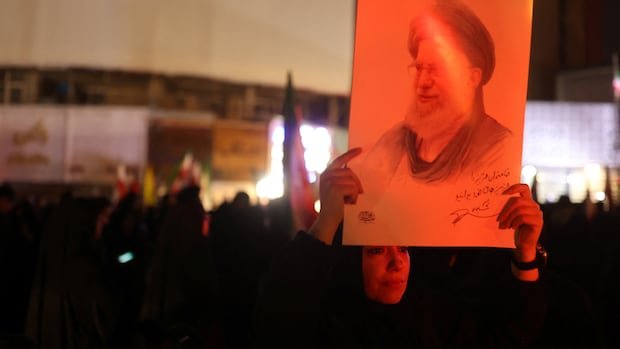

In the aftermath of the recent demise of Iran’s supreme leader due to actions by the U.S. and Israel, there has been widespread speculation and uncertainty regarding the leadership succession following Ayatollah Ali Khamenei’s death. This marks only the second instance since the 1979 Islamic Revolution that a new supreme leader is being chosen.
Ayatollah Khamenei, who governed Iran for 37 years, passed away on Saturday without a designated successor. One of the prominent names being discussed as a potential successor is Mojtaba Khamenei, one of Khamenei’s sons, although there has been no official confirmation yet. Considering the U.S.’s stance on regime change, appointing the son of the deceased leader might not align with the Trump administration’s preferences.
In the current interim period, the powers of the supreme leader have been temporarily transferred to a group comprising the Iranian President Masoud Pezeshkian, judiciary chief Gholam-Hossein Mohseni Eje’i, and senior Shia cleric Ayatollah Ali Reza Arafi. Iran’s Foreign Minister Abbas Araghchi announced that a new supreme leader would be selected within the week.
The selection of the new supreme leader theoretically falls under the purview of the Assembly of Experts, consisting of 88 Shia clerics whose candidacies are approved by Iran’s constitutional watchdog, the Guardian Council. However, uncertainties loom over this process due to ongoing attacks in the country, with reports indicating that the building where the Assembly was convening had been targeted.
Several potential successors have been mentioned, with Mojtaba Khamenei, Ali Reza Arafi, Hassan Khomeini, and Reza Pahlavi among the names floated. Mojtaba Khamenei, known for his connections to Iran’s Islamic Revolutionary Guard Corps (IRGC), has never held an official position, and his current status remains unknown.
Reza Pahlavi, the exiled son of Iran’s last shah, has emerged as another possible successor, particularly among those advocating for regime change outside Iran. However, doubts have been raised, notably by President Trump, regarding Pahlavi’s acceptance within Iran as a leader.
Trump has urged the Iranian people to take charge of their government, hinting at potential successors but refraining from naming specific individuals. The future leadership landscape of Iran remains uncertain, with various scenarios ranging from a transition to democracy to the rise of a military dictatorship or even a regime collapse and subsequent power vacuum.
The push for change in Iran has gained momentum in recent months, with calls for a shift towards a democratic system growing louder. However, the path to a democratic Iran remains unclear amidst the complex dynamics at play in the country’s political landscape.