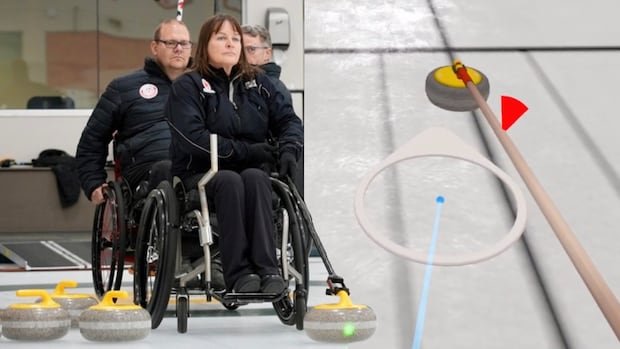

With less than two months to go until the 2026 Paralympic Games commence in Italy, Canada’s wheelchair curling team is intensively preparing for the competition. This year, an innovative virtual reality program developed in Alberta aims to enhance the team’s performance.
Jennifer Dornstauder, the engineering technical lead of the project created at Red Deer Polytechnic, highlighted the uniqueness of the program designed specifically for seated users. The VR simulation allows athletes to visualize their body movements, offering a training environment free from physical constraints.
The Canadian wheelchair curling team has consistently secured podium placements at every Paralympics, standing out as the only country with such a record. Embracing innovation has been a key factor in their success.
Wheelchair curling, often dubbed as “chess on ice,” requires strategic precision due to the absence of sweeping. The VR technology is set to elevate the team’s gameplay by providing a platform for strategic training and shot visualization.
The simulation mirrors the competition arena, aiding athletes in familiarizing themselves with the environment. This familiarity is crucial for mental preparation and adapting quickly to the competitive setting.
The integration of VR in wheelchair curling signifies a progressive shift in the sport, with athletes like Terry Fowler emphasizing the continuous pursuit of improvement and technological advancements to enhance performance.
Gil Dash, a member of the national team, emphasized the importance of utilizing every available tool to strive for excellence and potentially clinch a medal at the Paralympics.
The development of the VR technology stemmed from a collaboration between Dornstauder and Curling Canada officials, resulting in the creation of a specialized online simulator named “Chess On Ice.” The development process, led by a team of animators and programmers, was challenging but ultimately rewarding.
The software aims to evolve further, with plans to introduce features like a heat map, multiplayer mode, and a scoreboard. The goal is to not only enhance the current team’s performance but also to attract new athletes and promote the sport to a broader audience.
Overall, the implementation of VR technology in wheelchair curling illustrates a commitment to advancement and excellence within the sport, setting a precedent for future innovation in adaptive sports.