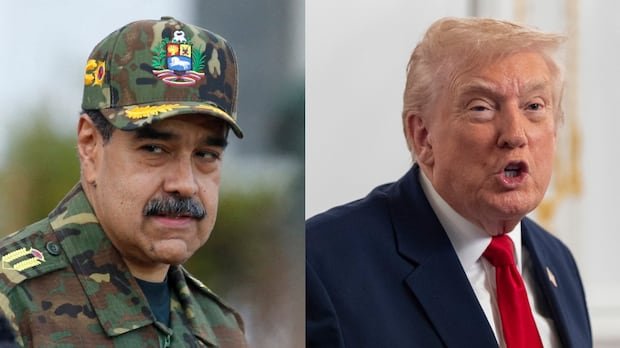

Leaders worldwide are swiftly reacting to reports of a U.S. assault on Venezuela and the apprehension of President Nicolás Maduro and his wife, Cilia Flores. Some leaders are responding diplomatically by monitoring the situation and advocating for the rule of law, while others are strongly denouncing the U.S.’s actions as “unacceptable.”
The news emerged early Saturday after the U.S. government conducted an attack on the oil-rich nation, resulting in the removal of Maduro and his wife from the country — a significant escalation in the U.S.’s already contentious stance towards Venezuela. U.S. President Donald Trump initially disclosed the events on social media shortly after 4:30 a.m. ET. Subsequently, Maduro and his wife were indicted in the U.S. District Court in the Southern District of New York, according to U.S. Attorney General Pam Bondi.
Global officials are closely monitoring the developing situation, which is reported to be the most direct U.S. intervention in the region since 1989.
In Latin America, officials from various countries promptly issued responses. Right-wing nations in the area have expressed more support for the U.S.’s actions, contrasting with left-wing government-led countries that have strongly condemned the intervention.
Brazilian President Luiz Inácio Lula da Silva issued a detailed and critical response, denouncing the bombings on Venezuelan territory and the capture of its president as an unacceptable transgression. Lula emphasized that such actions represent a flagrant violation of international law and a threat to regional peace.
Mexico, Chile, Cuba, and Uruguay have stated their non-support for foreign military interventions, with Mexico emphasizing the importance of dialogue and negotiation to resolve differences peacefully. Meanwhile, Trump supporters in Argentina, Peru, and Ecuador have shown support for the developments.
Reactions globally varied, with Russia expressing extreme concern over Maduro’s capture, labeling it a grave violation of sovereignty and international law. Iran and China strongly criticized the situation, while traditional U.S. allies called for restraint and adherence to the rule of law.
In Europe, officials refrained from condemning Trump’s actions, opting instead to closely monitor the situation. They emphasized the importance of upholding international law and the UN Charter while supporting a peaceful and democratic transition in Venezuela. Spain’s Prime Minister Pedro Sánchez rejected a U.S. intervention violating international law and urged all parties to prioritize the civilian population and pursue a fair and dialogued transition.
European leaders, such as Slovakian Prime Minister Robert Fico, viewed the U.S. military action in Venezuela as further evidence of the breakdown of the post-World War II world order. Several countries, including Italy and Poland, confirmed coordination with embassies in Venezuela to assist their citizens in the country.