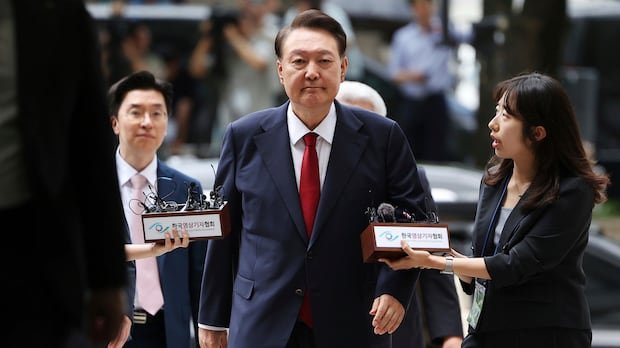

A former South Korean president, Yoon Suk Yeol, has been sentenced to five years in prison by a South Korean court for impeding authorities from arresting him after his failed attempt to implement martial law in December 2024. The Seoul Central District Court found Yoon guilty of directing the presidential security service to obstruct the execution of an arrest warrant issued by a court to investigate his declaration of martial law. Yoon was also convicted of producing fake official documents and disregarding legal procedures concerning martial law.
This ruling marks the first judicial outcome in the criminal case against Yoon related to his unlawful martial law declaration. The lead judge in the three-justice panel stated that Yoon misused his presidential authority to prevent the execution of lawful warrants through officials from the Security Service, essentially turning loyal officials into a private force for personal benefit and security.
Yoon’s supporters protested outside the Seoul Central District Court following the verdict. Yoo Jung-hwa, one of Yoon’s lawyers, announced that they would appeal the decision, expressing disappointment at what they perceive as a politicized judgment. Yoon could potentially face the death penalty in a separate trial for orchestrating an insurrection by declaring martial law without valid reasons.
Yoon has defended his action, claiming that as president, he had the authority to declare martial law to highlight the obstruction of government by opposition parties. Despite denying the charges, Yoon faced a possible sentence of up to 10 years for obstructing justice when he barricaded himself in his residence and ordered the security service to impede investigators.
After a second attempt involving over 3,000 police officers, Yoon was eventually arrested, making him the first sitting president in South Korea to face such action. Parliament, with support from members of Yoon’s conservative party, swiftly annulled his martial law decree and proceeded to impeach him, stripping him of his powers. Yoon was ousted from office by the Constitutional Court in April the following year for breaching his presidential duties.
Although Yoon’s brief martial law declaration lasted only a few hours, it caused significant unrest in South Korea, a major economy in Asia, a crucial U.S. ally, and historically known for its strong democratic values.