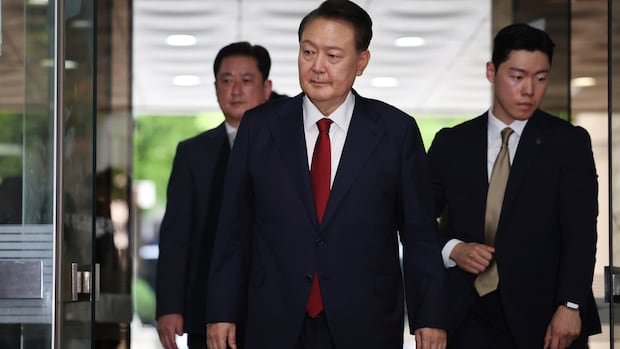

An independent prosecutor urged the imposition of the death penalty for former South Korean president Yoon Suk Yeol on charges of rebellion due to his brief declaration of martial law in December 2024. Yoon, who was ousted from office and is currently incarcerated, is facing multiple trials for various criminal offenses stemming from the martial law incident and other controversies during his tenure. The most serious accusation is that he orchestrated a rebellion.
The legal team led by independent counsel Cho Eun-suk petitioned the Seoul Central District Court to sentence Yoon to death, characterizing his actions as “anti-state activities” and a “self-coup.” They claimed that Yoon’s intent was to extend his rule by dismantling the constitutional governance structure. Yoon, during his court appearance, criticized the investigations into the rebellion charges, denouncing them as “frantic” and accusing them of being manipulated and distorted.
Yoon, known for his conservative stance, reiterated that his martial law decree aimed to alert the public to what he perceived as threats from the liberal opposition Democratic Party, which obstructed his policies using its legislative majority. He argued that the use of emergency presidential powers should not be equated with rebellion. The court is anticipated to render its decision in February, with experts predicting a likely life sentence for Yoon. South Korea has not carried out any executions since 1997, and death penalties have been infrequently issued by local courts in recent years.
Yoon is poised to become the first former South Korean president facing a potential death sentence post-office, following the case of former military leader Chun Doo-hwan, who was sentenced to death in 1996 for leading a coup in 1979. Chun’s death penalty was later commuted to life imprisonment and he was eventually pardoned.
Yoon’s martial law decree, a rare move in over four decades, involved deploying armed forces to encircle the National Assembly and election offices in Seoul. While no major injuries were reported, the incident revived memories of past dictatorships where martial law was used to suppress democratic protests. On the night of the declaration, thousands gathered at the National Assembly to oppose Yoon’s actions, leading to lawmakers voting against the decree.
Observers viewed Yoon’s decision as political suicide, culminating in his downfall from a former star prosecutor who won the presidency in 2022 to being impeached and subsequently dismissed by the Constitutional Court. The aftermath of Yoon’s decree caused political chaos, disrupted diplomacy, and shook financial markets in South Korea.
Lee Jae Myung, a former Democratic Party leader instrumental in Yoon’s impeachment, won the snap election last June and assumed the presidency. After his inauguration, Lee appointed three independent counsels to investigate allegations involving Yoon, his spouse, and associates. The presidential office expressed confidence in the judicial process aligning with legal standards, principles, and public expectations. Speculation suggesting Yoon’s martial law declaration was to shield his wife from corruption probes was dispelled by independent counsel Cho’s team, which concluded that Yoon had schemed for over a year to eliminate rivals and consolidate power through martial law.