
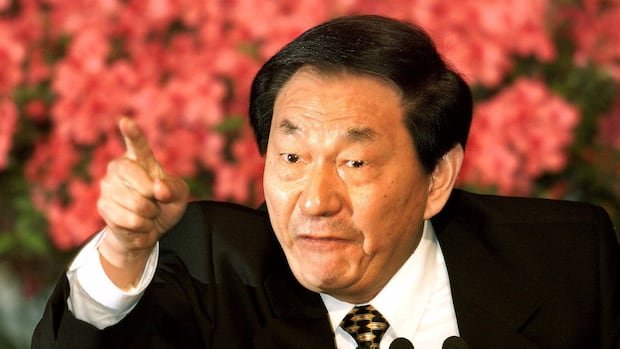

Former Chinese premier Zhu Rongji has passed away at the age of 97, as confirmed by state media reports. The official Xinhua news agency announced that Zhu died in Beijing due to illness around 11 a.m. on Wednesday. Known for his impatience and sharp-tongued demeanor, Zhu played a pivotal role in driving China’s economic growth during the 1990s by implementing significant reforms within the state industry and guiding the country’s entry into the World Trade Organization.
Despite facing challenges earlier in his career, including being exiled to rural areas for advocating reforms in other communist nations, Zhu spearheaded a series of sweeping changes during his tenure as premier from 1998 to 2003. His initiatives, aimed at enhancing efficiency and profitability within state-owned enterprises, led to massive layoffs but ultimately contributed to China surpassing Japan to become the world’s second-largest economy after the United States in 2010.
Building upon the reforms initiated by Deng Xiaoping in 1979, Zhu’s leadership was instrumental in securing China’s membership in the WTO, a move that transformed the nation into a global export powerhouse. These reforms helped sustain robust economic growth, with rates exceeding eight percent annually from 2000 to 2010, peaking at 14.2 percent in 2007.
Revered for his no-nonsense approach, Zhu earned the monikers “Boss” and “Madman Zhu” for his uncompromising stance against corruption and inefficiency. His commitment to accountability was evident when he famously remarked in 1998, “I have prepared 100 coffins here — 99 for corrupt officials and one for myself.” Zhu’s dedication to reform and transparency resonated with the public, solidifying his popularity during his tenure.
Zhu’s legacy includes kickstarting China’s housing market boom in 1998 by initiating the sale of state-owned apartments, thereby significantly increasing private homeownership in urban areas. While advocating for market-oriented reforms in various sectors, such as banking and energy, Zhu remained steadfast in preserving government ownership rather than pursuing wholesale privatization of the economy.
Born on October 23, 1928, in Hunan province, Zhu’s career trajectory was marked by periods of adversity, including being labeled a “rightist” in 1957 and enduring a prolonged exile during the Cultural Revolution. However, his rehabilitation in 1979 paved the way for a remarkable ascent, culminating in his impactful leadership roles within the Chinese government.
Zhu’s tenure was characterized by a willingness to acknowledge and rectify official shortcomings, a departure from the party’s tradition of infallibility. His candid approach was evident in instances where he took responsibility for government failures, underscoring his commitment to transparency and accountability.
Known for his wit and humor, Zhu injected levity into the party’s image through his public demeanor and witty remarks. Notable among his achievements was the establishment of a tax system that redirected more revenue to the central government, a feat for which he humorously quipped about deserving a Nobel Prize in economics.
Zhu Rongji’s legacy as a reformist leader, economic architect, and advocate for accountability has left an indelible mark on China’s trajectory, shaping its evolution into a global economic powerhouse.