


Bulgarian Prime Minister Rumen Radev announced that two commercial ships were targeted by drones on Tuesday, marking the first assault on vessels within the NATO member’s exclusive economic zone in the Black Sea.
Radev stated, “This is an unacceptable attack within Bulgaria’s exclusive economic zone. It represents a clear breach of international and maritime law.”
After an emergency government session, Radev revealed that both sea and aerial drones struck the vessels around 3 a.m. local time, approximately 128 kilometers off the coast of Byala, Bulgaria.
The Togo-flagged ship, Alfa Watan, sustained severe structural damage and subsequently sank. There was no immediate update regarding the status of its crew, he noted.
The second vessel, Able, registered under the flag of Palau, caught fire following the attack. A Bulgarian ferry successfully evacuated all 18 crew members, with two sailors suffering serious injuries and transported to a hospital in Varna, according to Radev.
The source of the drones has yet to be determined.
Previous Day’s Deadly Black Sea Attack
Reports indicate that the Able was en route south while carrying wheat, whereas the Alfa Watan was traveling north with its cargo still unidentified, Radev added, mentioning that authorities are on alert for potential oil spills and environmental damage.
“As a nation responsible for the safety and well-being of all maritime activities within our exclusive economic zone, we must undertake emergency search and rescue operations, irrespective of who is at fault,” he stated.
“The current situation is severely disrupting maritime operations in the Black Sea, further escalating insurance costs and complicating shipping logistics,” Radev said.
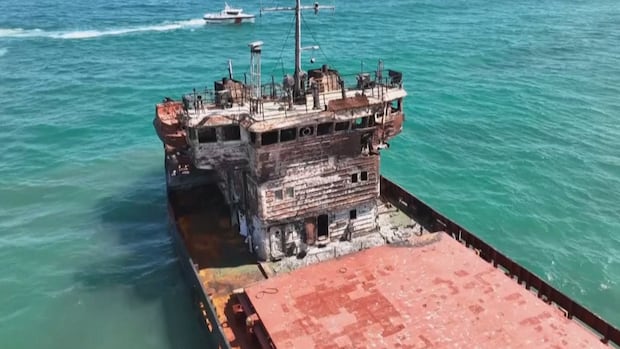
Escalating Russian attacks on Ukrainian ports and ships in the Black Sea have made getting crucial exports like wheat out of Ukraine much riskier. Russia claims it only hits military targets.
He cautioned that the ongoing conflict is expanding geographically, heightening the potential for a broader global confrontation.
NATO refrained from making any statements, directing all inquiries regarding the drone strikes to Bulgarian officials.
Last month, U.S. Gen. Alex Grynkewich, NATO’s senior commander, called on member nations to publicly identify those they suspect are responsible for drone incidents or sabotage once adequate evidence is available.
The German government took nearly a month to publicly assign blame to Russia for an attempted drone attack on August 4 at Leipzig/Halle Airport that involved explosives.
The drone attacks occurred just one day after a Turkish-owned cargo vessel carrying corn caught fire due to a drone strike and subsequently sank off the coast of Romania. Romanian officials reported two fatalities and the rescue of 11 crew members.
Ukrainian President Volodymyr Zelenskyy characterized that incident as “a horrifying attack by two Russian drones on a civilian ship” in neutral waters.
European Commission President Ursula von der Leyen, in a social media statement addressing both Monday and Tuesday’s incidents, condemned attacks on civilian vessels as unacceptable.
“Commercial ships — and innocent crews — are being targeted, with lives already lost at sea,” she remarked.
Russian forces are also seeking to impede shipping in Ukrainian Black Sea ports, which denies Kyiv essential revenue from grain exports.
On Tuesday, the Russian Defence Ministry reported that its forces had struck targets in Ukraine’s southern Odesa region along the Black Sea coast overnight with drones. They hit an ammunition depot, a bulk carrier in the Chornomorsk port transporting dual-use goods, and port infrastructure in Izmail, the ministry stated.
Meanwhile, Russia’s defense ministry claimed that its air defenses intercepted nearly 900 Ukrainian drones overnight across several regions, including the occupied Crimean Peninsula and the Sea of Azov.
Ukraine’s domestically produced long-range drones and increasingly, missiles, have enabled Kyiv to target Russian territory during the prolonged conflict that has lasted over four and a half years since Moscow initiated a full-scale invasion.