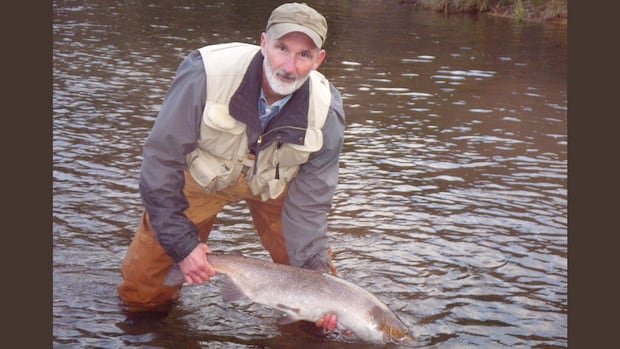

A federal advisory committee has broadened the roster of at-risk Atlantic salmon populations, causing concern among conservation organizations in Cape Breton. There are apprehensions that this revision may result in the cessation of recreational fishing for one of the East Coast’s emblematic species in the majority of New Brunswick, Prince Edward Island, and Nova Scotia.
While the Department of Fisheries and Oceans acknowledges this as a potential outcome, it stresses that it is not a foregone conclusion. The reassessment of salmon populations, including those along the entire coast of Nova Scotia and throughout the southern Gulf of St. Lawrence, was disclosed during federal fisheries meetings with stakeholders earlier this month by the Committee on the Status of Endangered Wildlife in Canada (COSEWIC).
During one of these meetings, René Aucoin, the president of the Cheticamp River Salmon Association, expressed his views. He highlighted that while salmon populations on Nova Scotia’s Atlantic coast are facing challenges, the situation is different on the western side of Cape Breton Island, where the rivers have shown significant improvement over the past decade.
Bill Hailey, vice-president of the Margaree Salmon Association, echoed Aucoin’s sentiments, emphasizing the healthy status of salmon in the Margaree River compared to the struggles faced by salmon in New Brunswick’s Miramichi River due to a flourishing striped bass population.
COSEWIC, an independent body of wildlife experts, advises the government on species at risk. Concerns have been raised by Hailey and Aucoin regarding the potential inclusion of Nova Scotia and southern Gulf salmon populations under the Species at Risk Act, which could lead to the discontinuation of recreational angling, including catch-and-release activities.
The process of officially listing the species as endangered under federal legislation is complex and protracted, involving public consultations with conservation groups, industry stakeholders, and First Nations. Despite the opportunity for stakeholders to present arguments against the reclassification, the lengthy timeline of the process remains a significant concern.
Robert Jones, the manager of biodiversity management in the Gulf region at DFO, emphasized that while the possibility of an endangered listing exists, a final decision will take into account scientific advice, as well as socio-economic factors. The assessment change is considered a serious step, with COSEWIC identifying the populations in the southern Gulf of St. Lawrence as endangered based on genetic and behavioral studies.
DFO has initiated an Atlantic salmon conservation strategy aimed at rebuilding fish stocks. Critics, however, argue that the strategy lacks adequate funding. The recommendations made by COSEWIC to Environment and Climate Change Canada will consider various factors, including economic impacts, conservation efforts, social implications, and Indigenous perspectives in the decision-making process.