
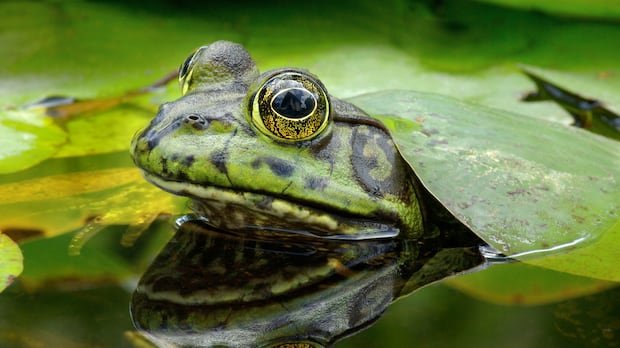

Residents in the Comox Valley on central Vancouver Island are uniting to eliminate invasive American bullfrogs from local lakes and water bodies. The Tsolum River Restoration Society is launching workshops to assist individuals in setting up tadpole traps, citing concerns over the threat these large bullfrogs pose to indigenous species.
American bullfrogs, known to be twice the size of other frogs in B.C., have a diverse diet that includes various species such as frogs, salamanders, insects, and even small mammals and reptiles, as highlighted by the Invasive Species Council of B.C.
One local resident has taken it upon himself to regularly check the tadpole traps he has placed in Maple Lake, just north of Cumberland, to safeguard the fragile ecosystems. Bruce Moffat, a society volunteer, initially adopted a “live and let live” approach towards the bullfrog tadpoles he first encountered a few years back. However, after witnessing an overwhelming number of invasive bullfrog tadpoles last year during a canoe trip on Maple Lake, Moffat felt compelled to get involved to prevent the potential decimation of local wildlife by these invasive creatures.
Moffat stresses that a significant population of American bullfrogs could severely impact local amphibians, fish, and insect populations, with cascading effects on birds and larger species. According to Moffat, the Invasive Species Council of B.C. warns that the voracious appetite of bullfrogs poses a threat to endangered species like the northern red-legged frog and the western painted turtle.
Gail Wallin, the executive director of ISCBC, emphasizes that capturing tadpoles or mature American bullfrogs and relocating them to a new area is illegal. While eradicating them completely may be challenging, Wallin encourages efforts to control their populations, with documentation of their activities being a crucial step in this process.
Wallin suggests trapping and euthanizing the American bullfrogs as a safe method for both individuals and the environment. She underscores the importance of ongoing community initiatives, like the tadpole traps set up by Comox Valley residents, to help manage local bullfrog populations.
The Tsolum River Restoration Society is hosting workshops in the Comox Valley to educate residents on constructing tadpole traps. These traps are designed to attract and temporarily capture bullfrog tadpoles, made from easily accessible materials. Katie Gair, the project co-ordinator, mentions that the workshops aim to empower community members to use these traps responsibly on their properties and in designated areas.
Gair explains that American bullfrog tadpoles can be distinguished by their larger size compared to native species, along with their cream-colored belly and mottled green speckling. Removing bullfrogs is just one aspect of a comprehensive strategy to safeguard local species, as outlined by the Tsolum River Restoration Society.