
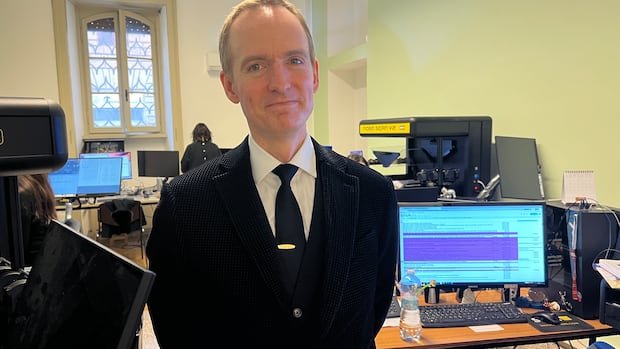

Matthew Harvey Sanders expressed his excitement upon discovering ChatGPT as a solution to a longstanding issue he had been grappling with. Standing in the contemporary library of the Vatican’s Pontifical Oriental Institute, the 43-year-old Torontonian, known for his serious demeanor and clerical attire, is immersed in a vast collection of books on Eastern Catholic traditions.
Sanders is the driving force behind Magisterium AI, a Catholic-focused artificial intelligence platform that he established and leads as CEO. His team, located near Rome’s Termini station, diligently scans thick theological volumes using large scanners and robotic arms to digitize significant works of the church’s doctors and fathers.
Despite its unconventional genesis, Magisterium AI has become the most widely utilized Catholic AI chatbot globally. Sanders, a former Anglican who converted to Catholicism after a profound experience studying Catholic Church history, noticed a gap in accessing the church’s intellectual heritage. His journey led him to Rome, where he transitioned from a technology consultant to the visionary behind Magisterium, largely supported by private Catholic donors.
Unlike general-purpose AI systems like ChatGPT, Magisterium is meticulously trained on primary Catholic sources, ensuring accuracy and reliability in responses by providing direct citations to the referenced material. Sanders emphasizes the importance of not solely relying on AI for faith-related queries, urging users to verify information themselves.
Although the Vatican has not officially endorsed the platform due to the continuous evolution of AI models, Sanders proudly displays a letter from Pope Leo XIV that recognizes the innovative work of Catholic AI developers, acknowledging the role of technology in the divine act of creation.
Under Leo’s papacy, a strong focus has been placed on artificial intelligence, with a recognition of its potential to reshape societal norms and human understanding. Magisterium has gained traction in 185 countries, catering not only to clergy but also to lay Catholics seeking answers to moral dilemmas and personal struggles.
Sanders sheds light on the platform’s user demographics, noting a prevalence of male and Gen Z users grappling with issues such as pornography addiction, sexual identity, and moral conflicts. While Magisterium serves as a valuable resource, Sanders emphasizes that it should complement, not replace, traditional spiritual guidance.
As Magisterium navigates the fine line between being a tool for knowledge dissemination and a facilitator of meaningful connections, experts caution against overreliance on AI for spiritual matters. The platform’s unique approach to integrating faith-based content aims to bridge the gap between technology and theology, offering a digital gateway to the vast intellectual tradition of the Catholic Church.