
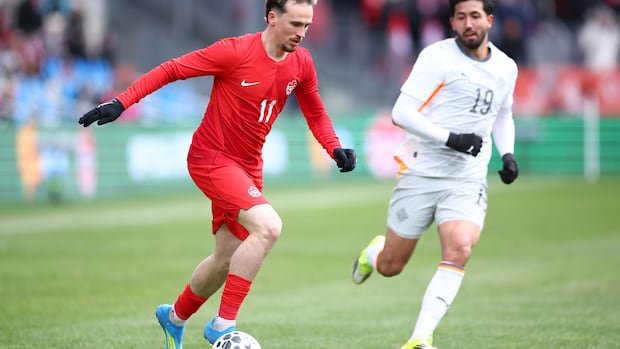

In the realm of every team, there exists a distinct leader — not necessarily the star player or the most vocal individual, but someone whose mere presence embodies the essence of the sport and its boundless potential. Some players lead not by standing out but by blending seamlessly with the team dynamics.
Within Canada’s men’s team, the embodiment of such leadership might just be Liam Millar.
In October 2024, during a match with his English club Hull, Millar experienced a peculiar moment. Taking an inside step, he heard a sharp crack emanate from his knee. Strangely, he felt no pain and was uncertain if any harm had been done. The sound triggered a sense of déjà vu, reminding him of a previous arm injury. The notion crossed his mind that perhaps his leg had suffered a similar fate.
Despite the lack of pain, the team’s physiotherapists conducted tests on the field. Millar remained nonchalant, attributing the sound to a harmless crack like knuckles popping. However, as the game progressed, a deeper unease settled in. His kneecap felt unsteady, as if it had lost its mooring. “The strangest sensation I’ve ever had,” he later recalled.
Subsequently, he withdrew from the game. The physiotherapists explained that his knee, then a potential concern, would reveal the extent of the injury itself. Knees, they noted, act as self-diagnostic tools. Millar drove home without issue, casually descending to the kitchen for a snack and sprinting back upstairs to test his knee. Initially, he felt no discomfort.
“I held onto hope that everything might be alright,” Millar reflected.
Later that night, as he lay in bed, he awoke at 3 a.m. to a throbbing, swollen knee. In the dim light, he gazed at it and understood: he had torn his ACL, a dreaded injury for soccer players, particularly those like Millar who thrive on hard work and ground coverage.
“Sometimes, a single step alters everything,” he mused.
Allowing a few tears to fall, Millar resolved privately to return stronger. He refused to succumb to the fate of many who, post-injury, never regained their former prowess. “I refused to let it define me,” he asserted.
Some athletes ascend to greatness due to their physical prowess — height, speed, agility. Others surpass their physical limits through sheer mental fortitude. They achieve beyond what seems possible by pushing themselves beyond their physical constraints.
Millar embodies this ethos. However, his knee posed a challenge to his customary self-determination. Four months into his recovery, he encountered a roadblock. He described feeling disoriented, as if viewing the world through a lens clouded by fear and uncertainty. “Physically present, mentally elsewhere,” he noted.
The unwavering support of his family, coach Jesse Marsch, and teammates such as Theo Bair guided him towards clarity. Now, Millar has resumed playing the game he loves, epitomizing resilience and fortitude that could serve as a guiding light for the national team.
Following a remarkable rise in September, where consecutive victories against Romania and Wales propelled Canada to 26th in the world rankings, the men’s team has faced a slew of challenges — injuries, red cards, and inconsistent results. The recent draw with Iceland, ranked 75th, marked a low point for a team now positioned 30th globally, with limited matches remaining before co-hosting the World Cup.
“We focus on who’s present, not who’s absent,” Marsch emphasized.
Millar, present and resolute, is poised to start in the upcoming friendly against Tunisia after appearing as a substitute against Iceland. With profound insight into overcoming setbacks, he recognizes that the solution may not always lie in anger or sacrifice but perhaps in gratitude and joy.
“I realized I underappreciated soccer before my injury,” Millar admitted. “The trivial frustrations that once irked me seemed insignificant during my year away from the game. It made me realize the importance of camaraderie.”
The prospect of a home World Cup looms ahead, laden with uncertainties and trials inherent to human nature. Imperfect beings, much like their knees, face challenges. Yet, this momentous opportunity beckons, reminding players and fans alike, through Millar’s example, to cherish the privilege and joy that soccer brings.