
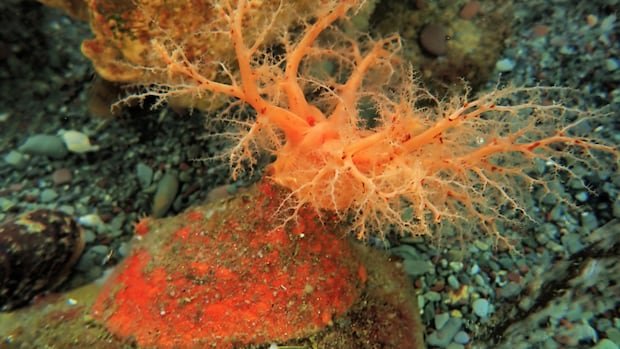

A recent discovery by a Canadian researcher reveals the remarkable ability of scarlet sea cucumbers’ amputated flesh to persist in a unique state between life and death for an extended period. Sara Jobson, a doctoral student at Memorial University in Newfoundland and Labrador, led the study uncovering what seems to be the tissue’s immortality.
Describing their findings as observing “little lab zombies,” Jobson and her team have witnessed a rare phenomenon where severed scarlet sea cucumber tissue remains viable independently. This unprecedented case challenges conventional expectations of tissue survival post-amputation.
In a groundbreaking study published in Science Advances, Jobson and her colleagues immersed sections of scarlet sea cucumber tentacles and tube feet in seawater to monitor their progression. The severed tissue exhibited a self-sterilizing process, sealing the wound edges to prevent contamination. Over several years, the tissue transformed into spherical, translucent structures containing a distinctive red pigment core.
Contrary to conventional regeneration processes, the tissue did not develop into new sea cucumbers but rather evolved into self-sustaining biological units. While exhibiting characteristics of living organisms such as nutrient absorption and immune responses, the tissue samples did not reproduce, leading to their classification as “zombie tissue” residing in an ambiguous state between life and death.
Despite the intriguing implications of this discovery, Jobson emphasized the unclear evolutionary advantages for scarlet sea cucumbers associated with this phenomenon. The potential applications of resilient tissue samples surviving independently present promising avenues for future scientific investigations, particularly in understanding cellular aging processes.
Acknowledging the pivotal role of curiosity-driven research in unveiling such novel insights, Jobson attributed her breakthrough to the supportive environment fostered by the lab led by Annie Mercier, a renowned professor of ocean sciences at Memorial University. This discovery highlights the importance of encouraging unconventional inquiries to unravel extraordinary scientific phenomena.