
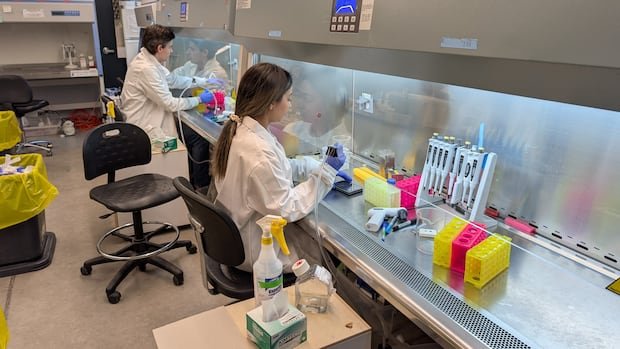

Charu Chandrasekera had a pivotal moment when she realized the limitations of animal testing in her biomedical research career. Witnessing her father’s need for a quadruple bypass surgery made her question the impact of her work on human patients. Studies show that despite the extensive use of animal testing, most drugs deemed safe in animals fail in human trials. This realization led Chandrasekera to establish the Canadian Centre for Alternatives to Animal Methods at the University of Windsor in 2017, focusing on innovative technologies like 3D bioprinted tissues using human cells for health monitoring.
However, due to insufficient funding, Chandrasekera had to close her lab in 2024, despite the significant impact of her center on the animal testing discourse in Canada. Unlike other nations like the U.K., the U.S., and the European Union, Canada lacks a comprehensive plan to replace animal testing in biomedical research, where a substantial number of animals are used annually. Moving towards alternatives to animal testing is crucial, considering its inefficiencies and the evolving landscape of scientific advancements.
The emergence of advanced technologies, such as organ-on-a-chip models and AI computational tools, offers promising alternatives to traditional animal testing methods. Researchers like Milica Radisic from the University of Toronto advocate for these innovative approaches, emphasizing the need to demonstrate their effectiveness to regulatory bodies for wider acceptance. While animal models have been invaluable in scientific research historically, the shift towards human-based technologies presents a more efficient and ethical path forward.
In Canada, the Canadian Council on Animal Care (CCAC) oversees ethical standards in animal research, promoting the 3R principles – replace, reduce, and refine animal use. While some animal testing remains necessary for data validation and public safety compliance, the focus is shifting towards embracing alternative methods where feasible. Policymakers and regulators play a crucial role in validating and integrating these new technologies into research practices, ensuring a balance between scientific progress and ethical considerations.
Despite global initiatives to phase out animal testing and invest in alternative approaches, Canada lags in allocating funds for this transition. The absence of financial support poses challenges for researchers like Chandrasekera and Radisic, potentially driving them to seek opportunities abroad. As the scientific community advocates for a paradigm shift towards humane and effective research practices, collaborative efforts and financial investments are essential for Canada to lead in advancing innovative alternatives to animal testing.