
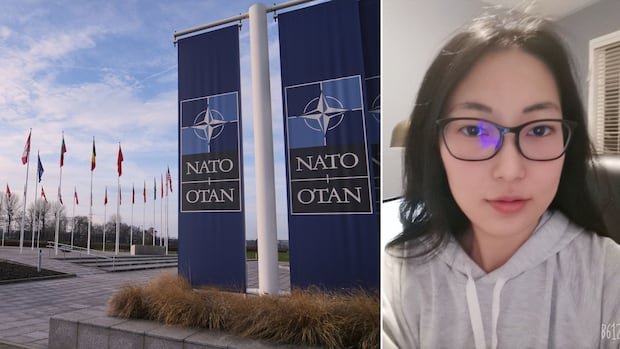

Several intelligence agencies in the Western world were caught off guard this summer as they tried to ascertain the extent of sensitive information accessed by an accused Canadian spy during her internships at various government departments and agencies.
Biwei Zhang, a Canadian intern at NATO’s military headquarters in Mons, Belgium, was apprehended by Belgian authorities in July on suspicion of espionage and ties to a foreign criminal organization. She has been in pretrial detention since her arrest and recently had her appeal for release denied.
Belgian officials have been tight-lipped about the case, declining to disclose her identity. However, a CBC News investigation in late July identified her through public records, revealing her diverse work history at prominent organizations like Statistics Canada, the Canadian Space Agency, the European Space Agency, and the World Trade Organization.
Although Belgian authorities have not explicitly named the country Zhang may have been spying for, reports from European media outlets, citing intelligence sources, suggest China’s involvement.
The Canadian Security and Intelligence Service (CSIS) confirmed its involvement in a comprehensive damage assessment across various government departments. According to CSIS spokesperson Magali Hébert, it is standard practice for agencies to conduct reviews to address potential repercussions in such security incidents.
Numerous confidential sources from intelligence and diplomatic circles have discussed the implications of Zhang’s alleged espionage activities. Kenneth Lasoen, an intelligence instructor at the University of Antwerp, emphasized the importance of a thorough investigation into her suspected espionage activities by European intelligence services.
The focus of the investigation revolves around determining the extent of Zhang’s access to sensitive information, evaluating potential damages caused, and uncovering any connections she might have had to a larger network.
In Canada, there is growing concern about how Zhang obtained security clearance, with a parliamentary committee planning to convene hearings on the matter. However, intelligence services are more interested in understanding the scope of information she may have gathered, potential accomplices, and her operational methods.
Experts are particularly interested in unraveling the nature of her activities at various agencies, both in Europe and Canada, and the duration for which security data is retained at each location. The investigation seeks to reconstruct her movements, access privileges, and any security breaches she may have exploited.
The case has raised questions about Zhang’s alleged ties to a criminal organization, as per Belgian law, which could have diplomatic repercussions. There is speculation regarding whether Zhang directly worked for Chinese military intelligence or a third-party criminal entity.
Authorities are also exploring potential links to third-party networks in Europe that have been known to collaborate with Chinese intelligence agencies. The involvement of Chinese overseas police stations in intelligence activities is another area of interest.
In conclusion, the investigation is ongoing to determine the full extent of Zhang’s activities, the potential risks posed by her actions, and the implications for national security in both Canada and Europe.