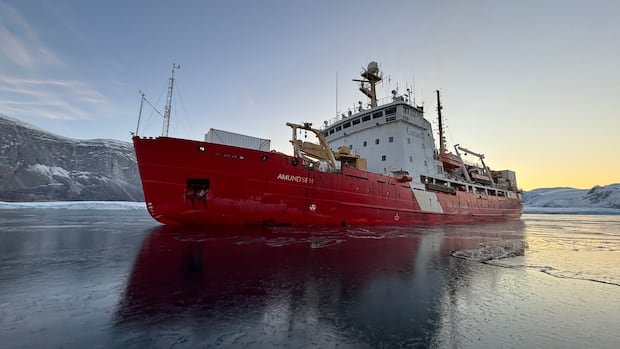

In Canada’s High Arctic, the waters surrounding the Queen Elizabeth Islands and western Tuvaijuittuq have long puzzled scientists due to their year-round sea ice cover. This ice has historically posed challenges for access. However, the melting sea ice has now enabled a Canadian research icebreaker to navigate through these previously impassable routes for the first time.
David Babb, a research associate at the University of Manitoba’s Centre for Earth Observation Science, noted the changes in the area saying, “We have lost ice, we have increased the area of open water, and the area is now more navigable.” On September 4, scientists from Fisheries and Oceans Canada (DFO) and the University of Manitoba embarked on a month-long research expedition aboard the CCGS Amundsen to study Arctic sea ice. This voyage marks the first comprehensive oceanographic research mission to reach this region of the Canadian Archipelago.
During the expedition, Babb identified two kinds of ice: seasonal ice, which forms over one winter and is thinner, and multi-year ice, which thickens over multiple winters. He observed a shift towards more seasonal ice and less multi-year ice, reflecting the rapid warming of the Arctic region. Some projections suggest that Arctic sea ice could vanish within this decade.
The entry of an icebreaker into this once impenetrable region serves as a stark indicator of the impacts of climate change. It also offers an opportunity for researchers like Babb to study this lesser-explored part of the Arctic and enhance future climate change projections. Despite the challenges faced in finding thick ice, the research team was able to gather valuable data on the deteriorating sea ice conditions in the area.
While located far from Nunavut communities like Grise Fiord and Resolute Bay, the research findings from the High Arctic are crucial as they have implications for southern regions with larger fisheries. The team engaged with the local community during their expedition, sharing knowledge and exchanging insights. The presence of mercury and phytoplankton in the ocean, as well as changing ice conditions, were among the topics discussed with community members, including students.
Teacher Rhonda McKenzie highlighted how elders in the community have observed faster ice melt and changes in traditional travel patterns due to shifting ice conditions. Efforts are underway to involve community members in measuring ice thickness, leveraging their invaluable on-the-ground observations for future research endeavors.
Overall, the expedition aboard the CCGS Amundsen signifies a significant milestone in Arctic research, shedding light on the rapidly evolving environmental dynamics in this remote region.
[End of Rewritten Article]