
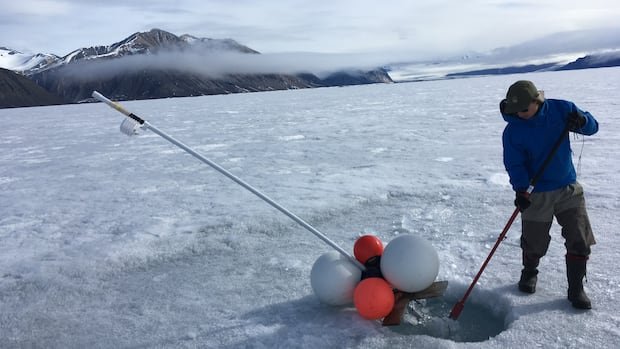

Canada’s sole remaining epishelf lake, characterized by freshwater floating on saltwater, has disappeared, leading to the loss of its distinctive ecosystem, as confirmed by researchers in a recent study. Jérémie Bonneau, an assistant professor at Laval University in Quebec City and the study’s lead author, expressed sorrow over the vanishing of the Milne Fiord epishelf lake on Ellesmere Island in Nunavut, emphasizing its uniqueness in Canada.
The disappearance of this lake, previously reported by scientists, is now detailed in a study recently published in the journal Scientific Reports. The irreversible loss of the lake signifies a significant shift in the ecosystem, marking the end of a 4000-year era due to the impact of a warming climate on the Arctic region.
Epishelf lakes form due to the blocking of freshwater flow into the ocean by ice shelves. In the case of the Milne Fiord, the ice shelf dammed the mouth for millennia, allowing freshwater to accumulate on top of the Arctic Ocean’s saltwater. This unique setup created a floating freshwater layer due to the lower density of freshwater compared to saltwater.
The lake’s distinct ecosystem was characterized by two separate layers of freshwater and saltwater, each supporting unique communities of bacteria, viruses, and phytoplankton. The lake’s freshwater layer, once 18 meters deep, had been accumulating for over 4,000 years. The lake was connected to the ocean by an under-ice channel in the ice shelf, which had been thinning for about a century.
Following the collapse of the Milne Ice Shelf in 2020, the lake disappeared as its water drained into the sea, leading to the immediate death of organisms living in the freshwater layer. The newfound marine environment resulting from the disappearance of the lake signifies a significant ecological transformation in the region.
The loss of Canada’s epishelf lake highlights the broader impact of climate change on unique ecosystems. While epishelf lakes are now absent in Canada, a few still exist in Greenland and Antarctica, though their future remains uncertain. Researchers warn that these ecosystems are increasingly vulnerable to the effects of a changing climate, underscoring the urgent need for conservation efforts to protect Earth’s natural beauty.