
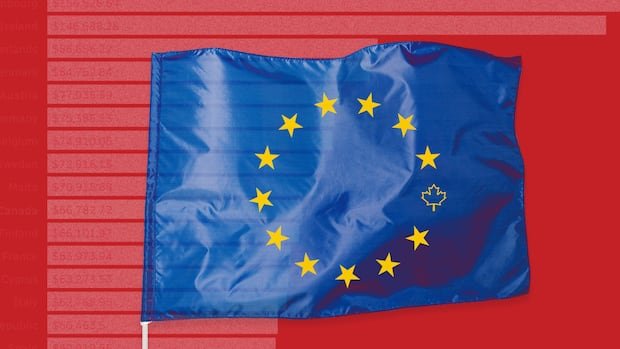

The European Union is aiming to designate Canada as its first “associate member” among the 27-member bloc as global trade partnerships diversify beyond the United States. European Commission President Ursula von der Leyen emphasized the need for the EU and Canada to reform their partnership beyond a simple free-trade agreement in a recent address.
Canadian Prime Minister Mark Carney expressed support for closer ties in his speech, emphasizing Canada’s pursuit of resilience and sovereignty. He proposed a deeper integration across critical sectors such as minerals, artificial intelligence, defense, energy, research, and finance.
Although the status of “associate member” is not officially recognized, Canada is poised to enhance its trade relations with Europe. Comparatively, Canada’s GDP per capita places it in the middle among EU countries, outperforming nations like France, Italy, and Spain but trailing behind Germany.
In terms of inflation, Canada has maintained a lower rate compared to many EU members, demonstrating resilience during the pandemic. However, Canada’s total debt-to-GDP ratio would rank among the highest in the EU if it were a member, following behind countries like France, Italy, and Greece.
Canada’s debt level has drawn attention from the International Monetary Fund, urging the government to prioritize reducing this ratio. Carney highlighted Canada’s low net debt-to-GDP ratio within the G7, emphasizing the distinction from the total debt-to-GDP metric.
Trade between Canada and the EU involves significant imports and exports, with Germany playing a central role. Canada imports machinery, vehicles, and pharmaceuticals from Germany while exporting energy products, ore, and precious metals.
Overall, the potential for Canada to become an associate member of the EU signifies a significant step towards expanding trade relationships with Europe.