

This article is part of Mind Your Business, a weekly review of significant business news sent to subscribers every Monday morning. If you haven’t subscribed yet, you can do that by clicking here.
Currently, the Canadian economy is grappling with two major issues.
On one side, inflation is elevated and continuing to rise. As of now, price hikes have primarily been limited to energy. Last month, inflation increased to 3.1 percent, but core indicators (which exclude more erratic elements) remained stable.
However, as demonstrated in the U.S., this containment is not permanent — and once price rises extend to other areas, it can be challenging to bring them back under control.
Conversely, the economy is underperforming. Furthermore, we have yet to fully assess the effects of the latest round of tariffs.
These two conflicting crises present a complex challenge for the Bank of Canada.
Typically, weak economic growth would lead the central bank to lower interest rates to stimulate growth. Yet, the rising inflation pressures the bank to increase rates in order to cool down the economy and prevent prices from escalating too swiftly.
Two issues — with two solutions that fundamentally contradict each other.
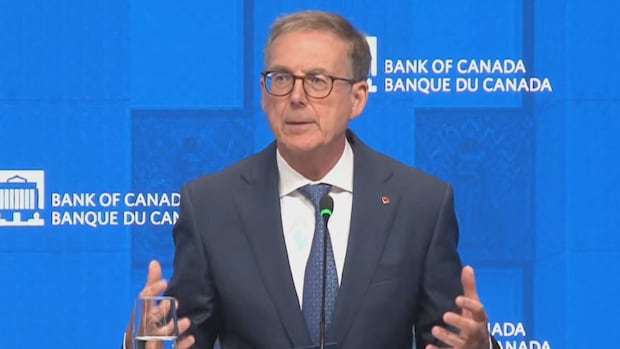
Bank of Canada governor Tiff Macklem states that while he hopes for a return to a ‘more normal’ Canada-U.S. relationship, he doesn’t foresee a return to ‘where we were’ while managing an American administration that supports tariffs and protectionist policies.
One by one, most major economic institutions in the country have revised their projections. The consensus now is that the Bank of Canada will increase its main overnight lending rate on Wednesday.
While they outline the economic rationale, Frances Donald and Nathan Janzen from RBC Economics remind us that the bank is viewing this year’s inflation surge through the lens of the previous surge — the pandemic-induced shock of 2022 to 2023.
“The cautionary lessons from the post-pandemic inflation spike … illustrated how supply-side shocks and ongoing cost pressures can swiftly overwhelm an economy,” wrote Donald and Janzen in a client note last week.
As a result, most economists now anticipate that the bank will raise rates, even if not all believe such a move is warranted.
Donald and Janzen suggest that a quarter-point hike won’t significantly alter their outlook for the economy. (They had, after all, based their predictions on the expectation that rates would rise next year.)
“Ultimately, the indication of a rate increase on Oct. 28 carries a broader implication we shouldn’t overlook: Central banks no longer exhibit the same tolerance for inflation they once did and are prepared to take pre-emptive action to mitigate it,” they stated.
-
Bond yields are soaring to multi-decade highs. What does that mean for Canadian consumers?
-
Sign up for Peter Armstrong’s weekly newsletter here
If we could magically rearrange the timing, it would be preferable for the economic data this week to be released in reverse order. The interest rate decision is scheduled for Wednesday, followed by GDP figures on Friday.
The GDP showed no growth in July (zero percent growth) and is projected to have grown by 0.1 percent in August. However, new tariffs were implemented that month, which means the forecast risks remain largely negative.
Uncertainty has become the new norm.
Both the Canadian economy and consumers have demonstrated greater resilience than anticipated. Nevertheless, each new challenge diminishes Canada’s potential growth.
On a positive note, we will also receive an update on the Bank of Canada’s projections this week. The Monetary Policy Report provides an in-depth analysis of the central bank’s economic outlook.