
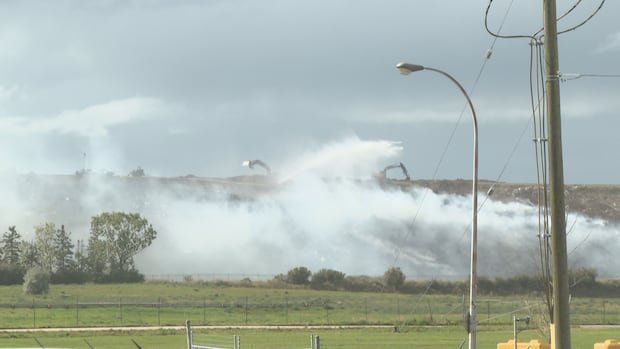

Alberta’s Minister of Environment has stated that the air quality data in the province indicates that the smoke from a fire burning at a landfill in southeast Calgary poses a low health risk for most of the city. However, in certain areas, the air quality has intermittently reached high-risk levels.
The Minister mentioned that a mobile air quality monitoring laboratory has been deployed by the province to monitor fine and coarse particulate matter. The primary air quality concern associated with the fire is particulate matter (PM) 2.5 from the smoke, which has exceeded Alberta’s ambient air quality guidelines.
PM 2.5 consists of inhalable particles less than 2.5 micrometres in diameter and can lead to serious health issues like lung and heart disease. The Minister highlighted that PM2.5 exceedances have occurred intermittently, with some monitoring periods showing concentrations comparable to the high-risk category of the Air Quality Health Index (AQHI).
The Minister emphasized that the elevated concentrations have been localized and influenced by changing plume and wind conditions, with the greatest risk of exposure in areas directly downwind of the fire. The fire, which started on September 6 at ECCO Recycling and Energy Corp.’s former landfill site, was initially suppressed but reignited on September 9.
ECCO has stated that the site only contains dry construction materials and has not accepted any new waste since 2024. The Calgary Fire Department issued a warning to residents in surrounding communities about worsening air quality and advised them to take precautions.
Calgary Mayor Jeromy Farkas and Coun. Rob Ward jointly sent a letter to the province requesting the immediate release of detailed air quality testing results. The Minister mentioned that air quality samples have been sent for expedited laboratory analysis to provide more information about the smoke’s composition.
He assured that all air-monitoring data and laboratory results collected in response to the incident will be publicly released for Albertans to access timely information about local air-quality conditions. Additionally, investigations are ongoing to determine if there were any unauthorized materials at the site, as it is only authorized to accept inert waste, not hazardous materials. Depending on the findings, enforcement actions could include warnings, penalties, or prosecution.