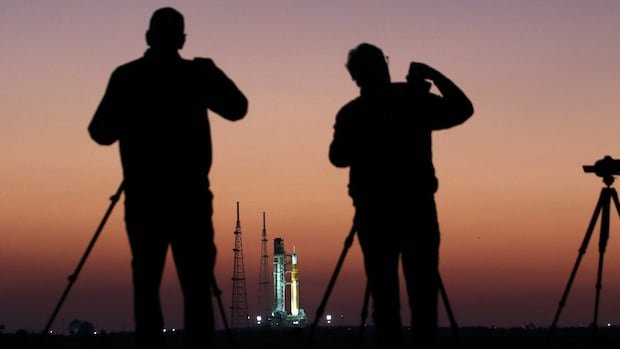

Artemis II is gearing up for its upcoming voyage around the moon and back, marking a significant milestone in human space exploration. The mission will see four crew members, including Canadian Space Agency astronaut Jeremy Hansen and NASA astronauts Reid Wiseman, Victor Glover, and Christina Koch, embark on this historic journey. They will be aboard the Space Launch System (SLS) rocket and the Orion spacecraft, launching from Kennedy Space Center’s Launch Pad 39B in Florida.
The mission’s launch schedule presents some challenges, with multiple launch windows determined by risk factors and system readiness. Previous launch attempts in February and March were postponed due to hydrogen and helium issues, as well as weather concerns. However, NASA has indicated an 80% likelihood of proceeding with the launch on April 1.
The initial launch window is set for Wednesday, April 1, from 6:24 p.m. to 8:24 p.m. ET. Should the launch be delayed, subsequent opportunities are available every night from April 2 to April 6. To ensure the correct trajectory for the moon and back, the launch is scheduled for nighttime, requiring some caffeine for East Coast spectators.
For those interested in witnessing the Artemis II launch in person, contact CBC News via email. Additionally, NASA offers detailed insights into the countdown minutes leading up to liftoff.
To keep pace with the mission, CBC’s team, including Science reporter Nicole Mortillaro, reporters Paul Hunter, and Karen Pauls, will provide comprehensive coverage across various platforms. Online coverage will commence two hours before the launch on CBCNews.ca, featuring live streaming of the event and real-time updates. The broadcast specials on Hanomansing Tonight and The National, streamed on YouTube, will commence around 6 p.m. ET on March 31.
Artemis II aims to test essential systems and astronaut responses in lunar orbit, setting the stage for future missions. Originally designed as a precursor to Artemis III’s moon landing in 2028, NASA’s recent reshuffling has altered the mission sequence, with Artemis III now planned as a low-Earth orbit test. The overarching goal of the Artemis missions is to establish a sustained presence on the moon, fostering scientific research and economic activities, with an eye towards eventual Mars exploration.
NASA’s heightened focus on lunar exploration aligns with ambitions to regain leadership in space exploration, bolstered by accelerated plans for a moon base and reevaluation of lunar gateway projects. The urgency to streamline launch processes stems from the need to match China’s rapid advancements in lunar missions, with China aiming to land astronauts on the moon by 2030. As Artemis II unfolds, it represents a crucial step towards these broader objectives, culminating in a 10-day mission ending with a splashdown in the Pacific Ocean.