
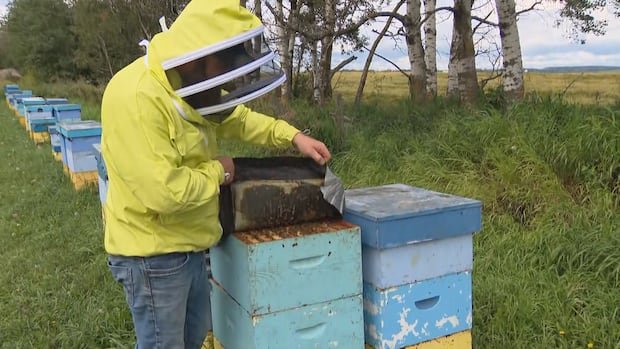

Harvest season is underway at a family-operated honey farm in central Alberta, but concerns loom over the potential impact of a trade agreement with the United States on this year’s honey crop. Lorne Prins, the owner of Gull Lake Honey, situated approximately 130 kilometers south of Edmonton, expressed frustration over the looming threat. The farm, with close to 3,000 hives spread across about 90 locations in Alberta, faces uncertainty due to the approaching August 19 deadline.
The proposed 50 percent tariff on Canadian honey by the U.S. administration has caused alarm among local producers like Prins, jeopardizing their primary export market. The sudden tariff threat, issued in July, caught industry stakeholders off guard as Canadian honey was previously exempt from tariffs under the Canada-U.S.-Mexico Agreement (CUSMA).
Adding to the challenges, the wet summer has already impacted honey production levels this year, further exacerbating concerns about potential price impacts from U.S. tariffs. Rod Scarlett, the executive director of the Canadian Honey Council, expressed surprise at the inclusion of honey among the goods facing potential tariffs.
With Alberta being Canada’s largest honey producer, generating over $241 million in revenues in 2025, the province plays a significant role in the national industry. Despite Prins primarily selling locally, the tariff implications could lead to a substantial drop in domestic honey prices if Canadian exporters lose their key international buyer.
Canadian beekeepers typically export around 70 percent of their honey to the United States. The recent tariff threat has prompted a rush to send shipments south before the deadline, with U.S. packers adjusting contract delivery dates and prices in response.
Jeremy Olthof, owner of Tees Bees, emphasized the added stress caused by the tariff threat in a year already disrupted by wet weather. While his operation does not heavily export to the U.S., he shares concerns about potential price declines affecting his business.
Barbara McKenzie, executive director of the Alberta Beekeepers Commission, warned of the catastrophic impact losing access to the U.S. market would have on Canadian producers. The potential collapse of exports could have far-reaching consequences, affecting not only the honey industry but also pollination of various food crops.
As the deadline approaches, Agriculture and Agri-Food Canada (AAFC) has engaged with industry groups to address potential impacts. Existing federal programs like AgriInvest and AgriStability are available to help mitigate losses, though applying after the enrollment deadline may incur penalties.
Trade negotiations are ongoing between Canada and the United States to resolve outstanding trade issues. Local producers like Olthof are left with uncertainty, hoping for a timely resolution to avoid the detrimental effects of the impending tariffs on the honey industry.