
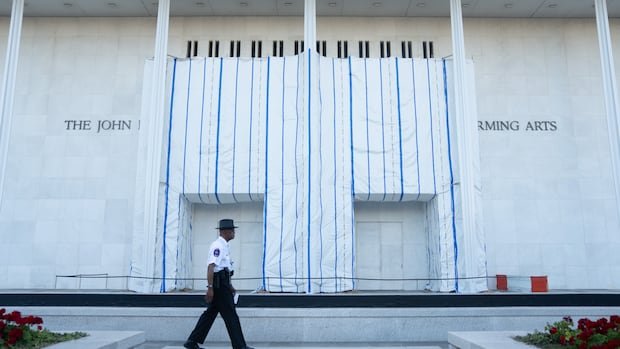

A federal judge in the United States has mandated that the Kennedy Center must give a 30-day notice before carrying out any significant alterations to the building, such as demolition, as threatened by President Donald Trump. The decision by U.S. District Judge Christopher Cooper aims to prevent confusion, especially in light of recent events, including the abrupt closure of the center to the public due to safety concerns linked to structural deterioration.
The Kennedy Center’s executive director and chief operating officer, Matt Floca, temporarily shut down the iconic performing arts venue citing acute risks to public safety arising from ongoing structural decay. The closure, which was implemented without prior notice, is slated to last at least seven days to evaluate safety risks in sections of the main building with severe structural issues.
This temporary closure is distinct from the board’s decision on Tuesday to indefinitely close the center for repairs following an inspection that revealed structural problems like a partial ceiling collapse. The closure may be prolonged pending further assessment next week.
The closure announcement followed legal action taken by a Democratic congresswoman who serves as a trustee and sought urgent court intervention to prevent what she deemed an “unlawful closing” of the building. Rep. Joyce Beatty, an Ohio Democrat and ex-officio board member of the Kennedy Center, has been leading efforts to oppose the addition of Trump’s name to the building and had a contentious interaction with the president during a recent virtual board meeting.
Beatty’s legal team argued in a court filing that the board’s claim of a temporary closure is a pretext to justify a permanent shutdown, expressing deep concerns about the situation. Despite denying a request for a hearing to clarify the board’s actions, Judge Cooper confirmed that his order prohibits any demolition of the building.
The board aligned with Trump, headed by the president himself, decided to close the center after a federal judge blocked the reinstallation of Trump’s name on the building. Trump, who was appointed chairman of the Kennedy Center by his loyalists last year, emphasized the urgent need for restoration efforts to prevent the building’s closure or demolition, highlighting its deteriorating and hazardous condition.
Although Congress has allocated $257 million for repairs, Trump insisted that progress would only proceed if his name were added to the building. Barbra Streisand, a past Kennedy Center honoree, criticized the controversy surrounding the center’s operations and questioned the necessity of its closure for repairs.
The Kennedy Center board previously proposed inscribing Trump’s name on the building and renaming the plaza in his honor, but these plans were rejected by Judge Cooper in August, ruling that congressional approval was required for any changes. Cooper had previously ruled in May that the addition of Trump’s name to the building was unlawful, resulting in its removal, albeit leaving behind remnants of the display.
These developments underscore the ongoing legal and operational challenges facing the Kennedy Center amid debates over its future and leadership decisions.